
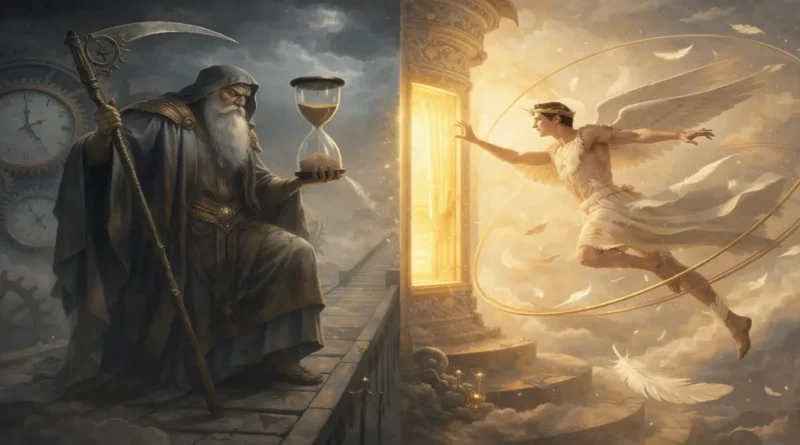
Saturn in Greek Mythology: Kronos, the Titan Behind the Roman God
Saturn in Greek mythology has a much stranger story than the benevolent Roman harvest god most people know — one where he swallowed his own children to dodge a prophecy, only to be overthrown by the one son who slipped through. That myth belongs to Kronos (also spelled Cronus), youngest of the Greek Titans and ruler of a lost Golden Age. When Roman writers absorbed Greek mythology centuries later, they matched Kronos to their own older harvest god, Saturn — and the two stories fused into one.
So if you’ve searched “Greek god Saturn” and come away confused, here’s the short version: the planet and the Roman deity are called Saturn, but the darker, more dramatic origin — the castration of the sky, the swallowed children, the war of the gods — is pure Greek, and in that world he goes by Kronos. This guide walks through the full myth, how the Roman version reshaped it, the famous mix-up with Father Time, and what all of it means when Saturn appears in your birth chart.
| Greek name | Kronos (Cronus) |
| Roman name | Saturn (Saturnus) |
| Role | Titan of time, the harvest, and the Golden Age |
| Parents | Uranus (sky) and Gaia (earth) |
| Symbol | The sickle / scythe |
| Overthrown by | His son Zeus (Roman Jupiter) |
| Planet & day | Saturn; Saturday, literally “Saturn’s day” |
Origins and Family, at a glance
Parents: Born to Gaia (Earth) and Uranus (Sky)
Rise to Power: Overthrew his father Uranus using an adamantine sickle
Consort: Married his sister Rhea (Roman equivalent: Ops)
Children: Father of the first Olympians — Zeus, Poseidon, Hades, Hera, Demeter, and Hestia
Downfall: Overthrown by his son Zeus after the ten-year Titanomachy
Who is Saturn in Greek mythology?
The Greek equivalent of Saturn is Kronos, leader of the Titans and the father of the first Olympian gods. The names differ, but the character is the same: the Romans did not invent Saturn’s story so much as inherit it. After Rome conquered the Greek world, Roman writers and artists took the well-developed myths of Kronos and attached them to Saturn, a much older Italian god of sowing and the harvest.
That is why almost every “Greek version of Saturn” question has the same one-word answer — Kronos — and why you will also see him called Cronus, which is just a different spelling of the same name. Keep that distinction in mind as you read: Kronos is the Greek Titan, Saturn is his Roman counterpart, and the planet in the sky carries the Roman name.
The myth of Kronos: castration, kingship, and the swallowed children
Kronos was the youngest child of Uranus, the sky, and Gaia, the earth. Uranus feared the strength of his own offspring and trapped them inside Gaia, who — furious and in pain — begged her children to act. Only Kronos was willing. Armed with an adamantine sickle his mother had forged, he ambushed Uranus, castrated him, and seized power for himself. It is a brutal origin, and it sets the tone for everything that follows: Kronos rises by overthrowing his father, and he will fall the same way.
As king of the Titans, Kronos presided over the Golden Age — a mythical era with no laws, no war, and no labor, when the earth gave up its fruit freely. But a prophecy warned that one of his own children would depose him, exactly as he had deposed Uranus. To escape that fate, Kronos did something monstrous: as each child was born to his sister-wife Rhea, he swallowed them whole. Hestia, Demeter, Hera, Hades, and Poseidon all vanished inside their father.
Rhea could not bear to lose another. When Zeus was born, she hid him away and handed Kronos a stone wrapped in swaddling clothes, which he swallowed instead. Zeus grew up in secret, then forced his father to disgorge his brothers and sisters — now fully grown gods. What followed was the Titanomachy, a ten-year war between the young Olympians and the old Titans. Zeus won, cast the defeated Titans into Tartarus, and took the throne of the cosmos. The wheel had turned once more.
Is Saturn the god of death?
This is a common question, and the honest answer is no — not directly. Kronos and Saturn are not gods of death in the way Hades rules the underworld or Thanatos personifies dying. Saturn’s core associations actually lean toward life: agriculture, the harvest, abundance.
But the confusion is understandable. Kronos is bound up with time, endings, and the closing of cycles — and time, taken to its conclusion, is what brings all things to an end. He is the god who devours, who ends the Golden Age, who represents the relentless forward march that no one escapes. In alchemy and old astrology his metal is lead: heavy, slow, and associated with decay. So while Saturn is not a death god, he carries the weight of finality, limits, and mortality — which is a large part of why the myth still resonates.
How Kronos became the Roman Saturn
Rome had worshipped Saturn long before it met Kronos. He was an ancient god of sowing and the harvest, honored on the Capitoline Hill, and his temple in the Roman Forum doubled as the state treasury. When Greek myth arrived, the Romans folded Kronos’s dramatic backstory into their existing Saturn — but they softened him.
The Roman Saturn kept the darker themes of time and cycles, yet he became known above all as a benevolent bringer of civilization and plenty. In Roman legend he did not end up imprisoned in Tartarus like Kronos; instead, after losing the throne to Jupiter (Rome’s Zeus), he fled to Italy, to a region called Latium, where the mortal king Janus welcomed him and shared power with him. There Saturn taught agriculture and law and ushered in a golden age of peace. His consort was Ops (the Roman Rhea), and together they were named as the parents of Jupiter, Neptune, Pluto, Juno, Ceres, and Vesta.
That is the tension at the heart of this figure: the fearsome Titan who ate his children, remembered by the Romans as a wise old king of a lost paradise.
Kronos vs. Chronos: the Father Time confusion
Here is a mix-up worth untangling, because it explains why Saturn is so often drawn as an old man with a scythe.
There are two similar Greek names. Kronos (Κρόνος) is the Titan we have been discussing. Chronos (Χρόνος) is something different — a personification of time itself, more a philosophical idea than a character in the myths. The two words are only one letter apart, and even the ancient Greeks began to blur them. A god who swallowed his children looked a lot like “all-devouring time,” so Kronos gradually absorbed the meaning of Chronos.
That fusion is why the imagery stuck. The sickle Kronos used against Uranus became the scythe of Father Time; his aged, cyclical nature became a symbol of the old year dying and the new one being born. When you see Father Time on a New Year’s card, you are looking at the long shadow of Kronos.
Saturnalia: the festival of Saturn
No account of Saturn is complete without Saturnalia, Rome’s most beloved festival. Beginning December 17, it celebrated Saturn’s Golden Age with a temporary return to that carefree world: businesses closed, wars and executions paused, and social order was cheerfully turned upside down. Enslaved people were served by their masters, gifts changed hands, and the whole city gave itself over to feasting and revelry.
Saturnalia’s timing near the winter solstice and the turn of the year — a season of both endings and renewal — fits Saturn perfectly, and many of its customs (gift-giving, feasting, goodwill) echo down into later midwinter holidays.
Saturn beyond Greece and Rome
The figure behind the ringed planet shows up across cultures. Ancient peoples independently tied the slow, distant planet to gods of time, judgment, and order: the Babylonians linked it to Ninurta, and in Hindu astrology the planet is Shani, a stern dispenser of karma and consequence. The through-line is consistent — Saturn is the cosmic figure of time, limits, and reckoning. And the everyday trace is right there in the calendar: Saturday is “Saturn’s day.”
What Saturn’s mythology means in astrology
For an astrologer, the myth is not trivia — it is the blueprint for how the planet behaves in a chart. Saturn is the taskmaster: the planet of time, structure, discipline, boundaries, and hard-earned maturity. Just as Kronos ended the effortless Golden Age, astrological Saturn strips away easy comfort and asks for effort, patience, and responsibility. Wherever Saturn sits in your chart is where you meet limits, do the work, and — eventually — build something lasting.
This is also why Saturn’s transits carry so much weight. As Saturn moves through each zodiac sign it puts a different area of life under pressure and review, and its roughly 29-year lap produces the famous Saturn return around ages 29–30 and 58–59, when many people face their biggest “grow up and rebuild” moments.
Reading the myth first makes those transits far easier to understand — because the lesson is always some version of the same ancient story: time passes, limits are real, and what you build under pressure is what endures.
Explore Saturn’s transits, sign by sign
Now that you know where Saturn’s themes of time, discipline, and hard-earned growth come from, see how they play out sign by sign:
- Saturn in Aries: dates and meaning and transit
- Saturn in Taurus: Dates and meaning
- Saturn in Cancer: dates, meaning, and transit
- Saturn in Gemini: dates, meaning, and transit
- Saturn in Leo: dates, meaning, and transit
- Saturn in Virgo: dates, meaning, and transit
- Saturn in Libra: dates, meaning, and transit
- Saturn in Scorpio: dates, meaning, and transit
- Saturn in Sagittarius: dates, meaning, and transit
- Saturn in Capricorn: an astrological timeline
- Saturn in Aquarius: entering and leaving dates
- Saturn in Pisces: when it leaves
- Saturn in Pisces Woman: personality explained
Frequently asked questions
Who is the Greek equivalent of Saturn?
His name is Kronos (also spelled Cronus) — but the one-line answer undersells him. He was the youngest of the Titans, father of the first Olympian gods, and the ruler whose fall from power is one of the most dramatic stories in Greek myth. See the full story above.
Is Saturn Greek or Roman?
The name “Saturn” is Roman. His myth, however, is largely Greek — the Romans adopted the story of the Greek Titan Kronos and attached it to their own older harvest god.
What is Saturn the god of?
Time, the harvest and agriculture, and the Golden Age of abundance. In astrology those themes become discipline, structure, limits, and karma.
Are Kronos and Cronus the same god?
Yes. “Kronos” and “Cronus” are two spellings of the same Greek Titan’s name.
Is Saturn Chronos or Kronos?
Saturn corresponds to Kronos, not Chronos. Kronos was the Titan king who fathered the Olympians; Chronos was a separate personification of time itself. The two names sound alike and merged over the centuries, which is why Saturn is often pictured with Father Time’s scythe — but strictly speaking, Saturn’s Greek counterpart is Kronos.
Is Kronos the same as Chronos, the god of time?
Not originally. Chronos was a personification of time; Kronos was the Titan. Their similar names caused the two to merge over the centuries, which is how Kronos became linked to Father Time and the scythe.
Is Saturn the grim reaper?
No. The grim reaper is a much later, medieval European personification of death, unrelated to Greek or Roman mythology. The scythe imagery overlaps because both figures draw on the same “Father Time” image born from the Kronos/Chronos mix-up — but Saturn himself was never a death god. His core domain was agriculture, the harvest, and time, not death.
Who overthrew Kronos?
His son Zeus (the Roman Jupiter), after Kronos swallowed his other children to prevent exactly that outcome.
Is Zeus Saturn or Jupiter?
Neither exactly, and both depending on which mythology you mean. Zeus is the Greek king of the gods, and his direct Roman equivalent is Jupiter — not Saturn. Saturn is Jupiter’s father (Kronos in Greek), the Titan that Zeus overthrew to become king.
Is Saturn a Titan?
Yes. In Greek mythology, Saturn’s counterpart Kronos was a Titan — specifically the youngest of the twelve Titans, the children of Uranus and Gaia. The Romans didn’t use the Greek “Titan” category for Saturn, but mythographers treat him as the Roman face of the same Titan figure.
Why is Saturday named after Saturn?
Saturday comes from “Saturn’s day,” part of the ancient practice of naming the days of the week after the classical planets and their gods.
Saturn in Greek mythology, in a nutshell
Saturn and Kronos are two names for one figure: a Roman harvest god fused with the Greek Titan of time who rose by overthrowing his father and fell to his own son. That story of cycles, limits, and hard reckonings is exactly what the planet still represents in astrology — which is why understanding the myth makes Saturn’s movements through your chart far easier to read.