
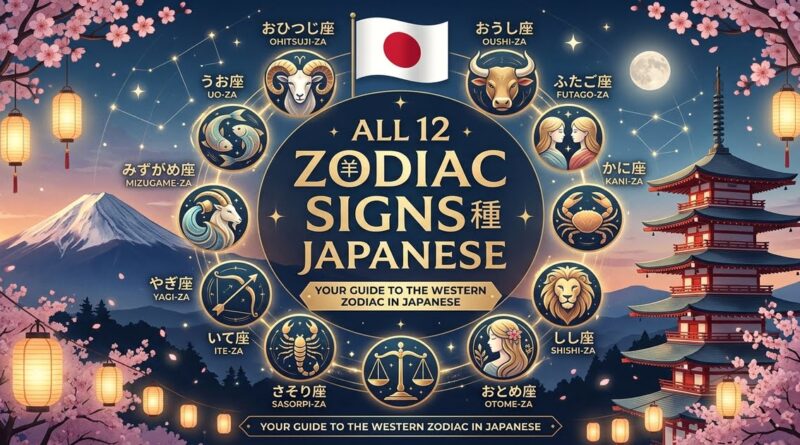
Zodiac Signs in Japanese: All 12 Names & Meanings
The zodiac signs in Japanese present a problem no European language does: you have to learn each name three times. Once as kanji, which is how it is written. Once as hiragana, which is how it is read. And once as romaji, which is how you will type it.
Before any of that, one disambiguation. 星座 (seiza) is the Western zodiac, the twelve signs tied to your birthday. 干支 or 十二支 (eto, jūnishi) is the twelve-year animal cycle — Rat, Ox, Tiger — tied to your birth year. Japanese uses both, constantly, and they are unrelated. This page is seiza.
All 12 Zodiac Signs in Japanese
Every name ends in 座 (za), “seat” — the same convention Chinese uses. In casual writing the first part is often left in kanji and 座 in kanji too; in horoscope columns you will frequently see the whole thing in hiragana for readability.
| English | Kanji | Hiragana | Romaji | Literally |
|---|---|---|---|---|
| Aries | 牡羊座 | おひつじざ | Ohitsuji-za | male sheep |
| Taurus | 牡牛座 | おうしざ | Oushi-za | male ox |
| Gemini | 双子座 | ふたござ | Futago-za | twins |
| Cancer | 蟹座 | かにざ | Kani-za | crab |
| Leo | 獅子座 | ししざ | Shishi-za | lion |
| Virgo | 乙女座 | おとめざ | Otome-za | maiden |
| Libra | 天秤座 | てんびんざ | Tenbin-za | balance scales |
| Scorpio | 蠍座 | さそりざ | Sasori-za | scorpion |
| Sagittarius | 射手座 | いてざ | Ite-za | archer |
| Capricorn | 山羊座 | やぎざ | Yagi-za | mountain goat |
| Aquarius | 水瓶座 | みずがめざ | Mizugame-za | water jar |
| Pisces | 魚座 | うおざ | Uo-za | fish |
Why Japanese Specifies the Sex of the Animal
Look at the first two entries. 牡 (o-) is a prefix meaning male, used for animals. So Japanese Aries is not a sheep but a male sheep, and Japanese Taurus is not cattle but a male ox.
No other language on this site does this. English “Aries” is silent on the matter; German Widder and Swedish Väduren mean “ram” and carry the sex inside the word rather than marking it separately; Chinese 白羊座 uses plain 羊, sheep, with no sex at all. Japanese is the only one with an explicit grammatical marker.
The reason is practical. Japanese 羊 (hitsuji) means sheep in general and 牛 (ushi) means cattle in general — neither word distinguishes male from female. To render the Latin Aries (a ram) and Taurus (a bull) precisely, Japanese had to add the marker. The counterpart 牝 (me-) marks females and does not appear in the zodiac at all.
The Four Hardest Japanese Star Signs to Read
These are the ones that defeat learners and, in two cases, native speakers reaching for a pen.
Aries in Japanese: 牡羊座 (おひつじざ)
Five syllables before you even reach the 座: o-hi-tsu-ji-za. The 牡 is read o here, not bo, which is its other reading. You will also see this written 牡羊座 and おひつじ座 interchangeably. See the Aries profile.
Virgo in Japanese: 乙女座 (おとめざ)
乙女 (otome) means a young unmarried woman — a maiden, not a virgin. It is a literary word, and it gives its name to otome games, the romance-simulation genre aimed at women. Japanese chose the softer reading, like the Scandinavian languages and unlike Chinese 处女座, which says virgin outright. More in the Virgo profile.
Scorpio in Japanese: 蠍座 (さそりざ)
蠍 is a genuinely difficult character — nineteen strokes, rarely used outside this word, and frequently written in hiragana as さそり座 precisely because of that. The reading sasori is native Japanese, not borrowed. See the Scorpio profile.
Pisces in Japanese: 魚座 (うおざ)
The trap here is that 魚 has two readings: sakana, the everyday word for fish as food, and uo, the older reading. The zodiac uses uo. Say sakana-za and you will be understood but instantly marked as a learner. See the Pisces profile.
The Six Straightforward Ones
Gemini in Japanese: 双子座 (ふたござ)
双子 (futago) is the ordinary word for twins. Same characters as Chinese 双子, different reading entirely. The Gemini profile has more.
Cancer in Japanese: 蟹座 (かにざ)
蟹 (kani) is a crab, and a word every visitor to Japan learns quickly from restaurant signage. A crab, not a crayfish. Read the Cancer profile.
Leo in Japanese: 獅子座 (ししざ)
獅子 (shishi) is a lion, but specifically the mythological, artistic lion — the guardian figure at shrine gates, the creature in shishimai lion dances. The zoological lion is usually ライオン (raion), from English. The zodiac uses the older word. See the Leo profile.
Libra in Japanese: 天秤座 (てんびんざ)
天秤 (tenbin) is a balance scale, the two-pan kind. Japanese uses the same characters as Chinese 天秤 with a completely different reading. There is a common Japanese idiom, 天秤にかける, “to put on the scales”, meaning to weigh two options. The Libra profile covers the sign.
Sagittarius in Japanese: 射手座 (いてざ)
射手 (ite) is an archer. Note that the same characters read shashu in other contexts, meaning a shooter or marksman — the zodiac takes the native ite reading. See the Sagittarius profile.
Capricorn in Japanese: 山羊座 (やぎざ)
山羊 (yagi) is a goat, written with the characters for “mountain sheep”. Japanese dropped the fish tail entirely and, unlike Chinese, did not keep the Sanskrit Makara — so Japanese Capricorn is a plain goat, aligning it with German Steinbock rather than with 摩羯座 next door. Read the Capricorn profile.
Aquarius in Japanese: 水瓶座 (みずがめざ)
水瓶 (mizugame) is a water jar. Like Chinese and Korean, Japanese makes this sign the vessel rather than the person carrying it — a real split from every European language, where Aquarius is a water man. See the Aquarius profile.
Talking About Zodiac Signs in Japanese
| English | Japanese | Romaji |
|---|---|---|
| star sign (Western zodiac) | 星座 | seiza |
| animal zodiac (birth year) | 干支 / 十二支 | eto / jūnishi |
| fortune-telling, horoscope | 占い | uranai |
| astrology | 占星術 | senseijutsu |
| birth chart | 出生図 / ホロスコープ | shusseizu / horosukōpu |
| blood type (asked alongside star sign) | 血液型 | ketsuekigata |
The phrases:
- 星座は何ですか? — Seiza wa nan desu ka? — What’s your star sign?
- 私は蠍座です。 — Watashi wa sasori-za desu. — I’m a Scorpio.
- 何座ですか? — Nani-za desu ka? — Which sign are you? (Casual and very common.)
- 乙女座っぽい。 — Otome-za ppoi. — Very Virgo.
Seiza and Uranai in Japan
Japan takes personality typing seriously enough to have two parallel systems, and star signs are only one of them. The other is 血液型 (ketsuekigata), blood type, which is used the way star signs are used elsewhere — A is meticulous, B is individualistic, O is easygoing, AB is unpredictable. It is entirely normal to be asked both.
Morning television carries daily uranai segments ranking all twelve signs from best to worst day, a format far more competitive than the Western one-paragraph-per-sign convention. It is also worth knowing that Japan is where the Western zodiac largely entered East Asian popular culture before spreading onward to China and Korea.
Frequently Asked Questions
How do you say “zodiac sign” in Japanese?
星座 (seiza) for the Western zodiac. 干支 or 十二支 (eto, jūnishi) is the twelve-year animal cycle, a separate system.
What are the 12 zodiac signs in Japanese?
牡羊座, 牡牛座, 双子座, 蟹座, 獅子座, 乙女座, 天秤座, 蠍座, 射手座, 山羊座, 水瓶座, 魚座 — Aries through Pisces.
Why do Japanese zodiac signs end in 座?
座 (za) means “seat” and marks the word as a constellation. Chinese uses the same character the same way; Korean uses its own equivalent, 자리.
What does the 牡 in 牡羊座 mean?
It marks a male animal. Japanese 羊 means sheep generally and 牛 means cattle generally, so the prefix was needed to render the Latin ram and bull precisely.
Is the Japanese zodiac the same as the Chinese zodiac?
The twelve-year animal cycle is shared with China, with one substitution — Japan’s version has the Boar rather than the Pig. The Western zodiac (星座) is a separate system entirely.
Are Japanese zodiac signs written in kanji or hiragana?
Both. 蠍座 and 牡羊座 are frequently written さそり座 and おひつじ座 because the kanji are difficult, and horoscope columns often use hiragana throughout.
Zodiac Signs in Japanese and Its Regional Neighbours
Japanese, Chinese and Korean built the same system three different ways. The zodiac signs in Chinese use several of these exact characters with entirely different readings, and kept the Sanskrit Makara at Capricorn where Japanese used a plain goat. The Korean list swaps 座 for 자리. The Vietnamese names are the Chinese characters read in Vietnamese.
All languages: zodiac signs in different languages.