
Zodiac Signs in German: All 12 with Articles, Dates & Pronunciation
The 12 zodiac signs in German (also known as star signs in German) form an essential part of daily vocabulary. Whether you are reading a horoscope or discussing German star signs with native speakers, the 12 signs are: der Widder (Aries), der Stier (Taurus), die Zwillinge (Gemini), der Krebs (Cancer), der Löwe (Leo), die Jungfrau (Virgo), die Waage (Libra), der Skorpion (Scorpio), der Schütze (Sagittarius), der Steinbock (Capricorn), der Wassermann (Aquarius), and die Fische (Pisces) in German.
Below you will find the complete table of all 12 signs with their German names, grammatical articles, English translations, pronunciation guides, and date ranges. We also explain the tricky der / die / das rule, how to say your sign in a sentence, and how the German zodiac compares to other languages.
All 12 Zodiac Signs in German (Zodiac auf Deutsch): Quick Reference Table
If you searched for “zodiac signs deutsch”, “zodiac deutsch”, or “zodiac auf deutsch”, the standard German word for a zodiac sign is das Sternzeichen. The complete set is called die zwölf Sternzeichen or, more formally, die zwölf Tierkreiszeichen.
Below is the complete comparison table with each English sign, German name, grammatical article, pronunciation, literal meaning, and date range.
| English | German | Article | Pronunciation | Listen | Literal Meaning | Dates |
|---|---|---|---|---|---|---|
| Aries | der Widder | der | VID-er | Ram | Mar 21 – Apr 19 | |
| Taurus | der Stier | der | SHTIR | Bull | Apr 20 – May 20 | |
| Gemini | die Zwillinge | die (pl.) | ZVIL-ing-e | The Twins | May 21 – Jun 20 | |
| Cancer | der Krebs | der | KREBS | Crab | Jun 21 – Jul 22 | |
| Leo | der Löwe | der | LÖ-ve | Lion | Jul 23 – Aug 22 | |
| Virgo | die Jungfrau | die | YUNG-froh | Maiden / Virgin | Aug 23 – Sep 22 | |
| Libra | die Waage | die | VAH-ge | Scales / Balance | Sep 23 – Oct 22 | |
| Scorpio | der Skorpion | der | SHKOR-pion | Scorpion | Oct 23 – Nov 21 | |
| Sagittarius | der Schütze | der | SHÜT-tse | Archer | Nov 22 – Dec 21 | |
| Capricorn | der Steinbock | der | SHTYN-bock | Sea-Goat / Mountain Goat | Dec 22 – Jan 19 | |
| Aquarius | der Wassermann | der | VA-ser-man | Water-Man | Jan 20 – Feb 18 | |
| Pisces | die Fische | die (pl.) | FISH-e | The Fish | Feb 19 – Mar 20 |
Why der, die, and das? The German Article Rule for Zodiac Signs
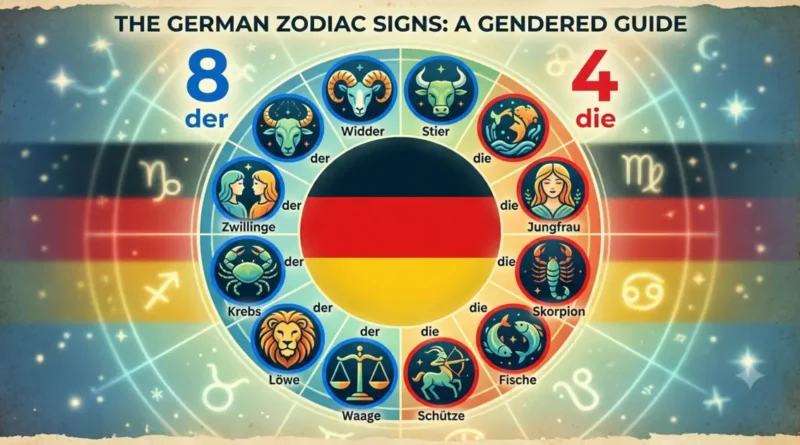
One of the biggest surprises for English speakers is that German zodiac signs have grammatical gender — and it is not based on whether the sign is male or female. Instead, it follows the grammatical gender of the sign’s name:
- 8 signs take der (masculine): Widder, Stier, Krebs, Löwe, Skorpion, Schütze, Steinbock, Wassermann
- 2 signs take die (feminine): Jungfrau, Waage
- 2 signs are plural and take die: Zwillinge (the twins), Fische (the fish)
- Zero signs take das — a common mistake learners make!
Quick trick: If the name ends in -e, it is usually die (feminine). The two plurals (Zwillinge, Fische) also end in -e but are plural. All other signs are der.
All 12 Zodiac Signs in German — Detailed Guide
Aries in German: der Widder
Aries is the first sign of the zodiac, associated with the ram. In German, der Widder shares the same root as the English “ram.” The word is also used in German for a male sheep. See the full Aries profile →
Taurus in German: der Stier
Der Stier is the German word for a bull. Unlike English, where “taurus” is Latin for bull, German uses the native Germanic word. The pronunciation is almost identical to the English “steer,” which also means a castrated bull. See the full Taurus profile →
Gemini in German: die Zwillinge
Unlike most signs, Gemini is plural in German because it represents twins. Die Zwillinge literally means “the twins.” This is one of only two plural zodiac signs (the other being Pisces). See the full Gemini profile →
Cancer in German: der Krebs
Der Krebs is the German word for crab. Interestingly, the sign is called “Krebs” in German rather than “Krebszeichen” (cancer sign) in everyday speech. The pronunciation is identical to the English word “crabs.” See the full Cancer profile →
Leo in German: der Löwe
Der Löwe is the German word for lion. The umlaut ö is pronounced by rounding your lips into an “o” shape while saying “ee.” This is a key sound for German learners. See the full Leo profile →
Virgo in German: die Jungfrau
Die Jungfrau literally translates to “the virgin” or “the maiden.” This is one of only two feminine zodiac signs in German. The name is also used in German astronomy for the constellation Virgo. See the full Virgo profile →
Libra in German: die Waage
Die Waage literally means “the scales” or “the balance.” Unlike English, which uses the Latin name “Libra,” German uses the native Germanic word. The word Waage is also the general German word for a weighing scale. See the full Libra profile →
Scorpio in German: der Skorpion
Der Skorpion is a direct loanword from Latin, similar to the English “scorpion.” The German spelling uses a k rather than a c, which is a common German orthographic convention. See the full Scorpio profile →
Sagittarius in German: der Schütze
Der Schütze literally means “the shooter” or “the archer.” This is a native Germanic word, unlike the Latin-derived English name. The umlaut ü is pronounced by rounding your lips into an “oo” shape while saying “ee.” See the full Sagittarius profile →
Capricorn in German: der Steinbock
Der Steinbock literally means “stone goat” or “rock goat.” This is a compound word common in German: Stein = stone, Bock = male goat. The sign is often depicted as a goat with a fish tail, reflecting its “sea-goat” origins. See the full Capricorn profile →
Aquarius in German: der Wassermann
Der Wassermann literally means “the water-man.” This is a native Germanic compound word: Wasser = water, Mann = man. Unlike English, which uses the Latin name, German describes the sign’s mythological origins directly. See the full Aquarius profile →
Pisces in German: die Fische
Die Fische is the second plural zodiac sign in German, alongside Gemini. The word Fische is the plural of der Fisch (the fish). This is a common source of confusion for learners, as the singular is der Fisch but the sign is always die Fische. See the full Pisces profile →
How to Say “I am [Zodiac Sign]” in German
In German, you say “Ich bin [der/die Sign].” You do not use an article after “Ich bin” — this is the #1 mistake English speakers make. Compare:
| English | German | Pronunciation |
|---|---|---|
| I am an Aries | Ich bin Widder. | Ich bin VID-er |
| I am a Taurus | Ich bin Stier. | Ich bin SHTIR |
| I am a Gemini | Ich bin Zwillinge. | Ich bin ZVIL-ing-e |
| I am a Cancer | Ich bin Krebs. | Ich bin KREBS |
| I am a Leo | Ich bin Löwe. | Ich bin LÖ-ve |
| I am a Virgo | Ich bin Jungfrau. | Ich bin YUNG-froh |
| I am a Libra | Ich bin Waage. | Ich bin VAH-ge |
| I am a Scorpio | Ich bin Skorpion. | Ich bin SHKOR-pion |
| I am a Sagittarius | Ich bin Schütze. | Ich bin SHÜT-tse |
| I am a Capricorn | Ich bin Steinbock. | Ich bin SHTYN-bock |
| I am an Aquarius | Ich bin Wassermann. | Ich bin VA-ser-man |
| I am a Pisces | Ich bin Fische. | Ich bin FISH-e |
💡 Pro tip: If you want to say “My zodiac sign is…” use Mein Sternzeichen ist… (singular, always ist, never sind):
- Mein Sternzeichen ist Widder.
- Mein Sternzeichen ist Waage.
Astrology in German: Essential Words and Phrases
Looking for astrology in German? The German word for astrology is die Astrologie, while a horoscope is das Horoskop. If you want to discuss zodiac signs in German, the most useful vocabulary is listed below.
| English | German | Example |
|---|---|---|
| Astrology | die Astrologie | Ich interessiere mich für Astrologie. |
| Horoscope | das Horoskop | Lies dein Horoskop. |
| Zodiac | der Tierkreis | Der Tierkreis hat zwölf Sternzeichen. |
| Zodiac sign | das Sternzeichen | Mein Sternzeichen ist der Löwe. |
| The 12 zodiac signs | die zwölf Sternzeichen | Der Tierkreis hat zwölf Sternzeichen. |
| Born under Aries | im Widder geboren | Ich bin im Widder geboren. |
Useful pronunciation:
- die Astrologie — as-TRO-lo-gee
- das Horoskop — ho-ros-KOHP
- der Tierkreis — TEER-kreis
- das Sternzeichen — SHERN-tsai-chen
Zodiac Signs in Other Languages
If you are learning multiple languages, here is how the zodiac signs translate across the languages we cover on HoroscopeBuz:
Ram, Stier, Tweelingen… →
Väduren, Tyren, Tvillingarna… →
Vædderen, Tyren, Tvillingerne… →
Væren, Tyren, Tvillingene… →
Ariete, Toro, Gemelli… →
Bélier, Taureau, Gémeaux… →
Frequently Asked Questions
How do you say “zodiac sign” in German?
In German, “zodiac sign” is das Sternzeichen (singular). The plural is die Sternzeichen. You will also hear das Tierkreiszeichen (literally “the zodiac animal sign”), but Sternzeichen is the everyday word.
What are the 12 zodiac signs in German?
The 12 zodiac signs in German are: der Widder (Aries), der Stier (Taurus), die Zwillinge (Gemini), der Krebs (Cancer), der Löwe (Leo), die Jungfrau (Virgo), die Waage (Libra), der Skorpion (Scorpio), der Schütze (Sagittarius), der Steinbock (Capricorn), der Wassermann (Aquarius), and die Fische (Pisces).
Which German zodiac signs take “die” instead of “der”?
Only two singular signs take die (feminine): die Jungfrau (Virgo) and die Waage (Libra). Additionally, two plural signs also take die: die Zwillinge (Gemini) and die Fische (Pisces). All other signs take der. No zodiac sign in German takes das.
Do you say “Ich bin Löwe” or “Ich bin ein Löwe”?
You say “Ich bin Löwe” — without an article. In German, after the verb sein (to be), you do not use an article for professions, nationalities, or zodiac signs. Saying “Ich bin ein Löwe” is grammatically incorrect and sounds unnatural to native speakers.
What are the German zodiac dates?
The German zodiac dates are the same as in English. For example, der Widder is March 21 – April 19 (März 21 – April 19 in German). You can find the full date range table above, with months written in both English and German.
Is “Zwillinge” singular or plural in German?
Die Zwillinge is always plural in German. It literally means “the twins.” There is no singular form for this zodiac sign. When you say “Mein Sternzeichen ist Zwillinge”, you are using the plural noun as a fixed sign name.
What is the difference between “der Krebs” and “Krebszeichen”?
Der Krebs is the everyday word for the zodiac sign Cancer. Das Krebszeichen is the more formal term, literally meaning “the cancer sign”. In casual conversation, Germans simply say Ich bin Krebs or Mein Sternzeichen ist Krebs.
How do you pronounce “der Löwe” and “der Schütze”?
Der Löwe is pronounced LÖ-ve — round your lips into an “o” shape while saying “ee”, then add “ve”. Der Schütze is pronounced SHÜT-tse — round your lips into an “oo” shape while saying “ee”, then add “tse”. Both use the German umlaut sound.
Are the zodiac signs in German the same as in English?
The sign names are different — German uses native Germanic words (Widder, Stier, Löwe) while English uses Latin names (Aries, Taurus, Leo). However, the dates, order, and symbolism are identical. The main difference is the grammatical articles: German adds der, die, or das before each sign name.
What is the German word for “astrology”?
The German word for “astrology” is die Astrologie. The word for “horoscope” is das Horoskop. A person who reads horoscopes is ein Horoskopleser (male) or eine Horoskopleserin (female).