
The High Priestess and Judgement Birth Cards: Meaning and Guide
If The High Priestess and Judgement are your tarot birth cards, your life keeps asking one gentle question: what do you know deep down, and when is it time to say it out loud? This pairing joins quiet intuition with a clear inner calling. Below you’ll find what the two cards mean together, the gifts and challenges of the pair, how it may show up in love, and practical ways to work with it.
Meet The High Priestess and Judgement
- Keywords: intuition, mystery, inner wisdom, awakening, calling, renewal
- Gifts: an inner compass, timely awakening, persuasive authenticity
- Challenges: sitting on your calling, seeking permission, harsh self-review
- Advice: act on a small call, choose your audience, replace judgment with review
Not sure these are your cards? Use our free tarot birth card calculator to find your birth cards from your date of birth.
What does it mean to have The High Priestess and Judgement as birth cards?
Having these two as birth cards suggests a life path built around inner knowing and answering a call. The High Priestess (2) stands for intuition, privacy and depth. Judgement (20) stands for awakening, accountability and responding to purpose. The two are linked by number: 20 reduces to 2 (2 + 0), which is why they arrive together.
Your first card, Judgement, tends to describe the theme you meet in the world. Your second card, The High Priestess, describes the inner source it grows from. Many people with this pair feel a pull between two modes: the reflective observer who prefers to keep things private, and the awakened person who wants to step forward and act. Neither side is the wrong one. Your growth comes from learning when each is needed.
The High Priestess (#2): what is she trying to tell you?
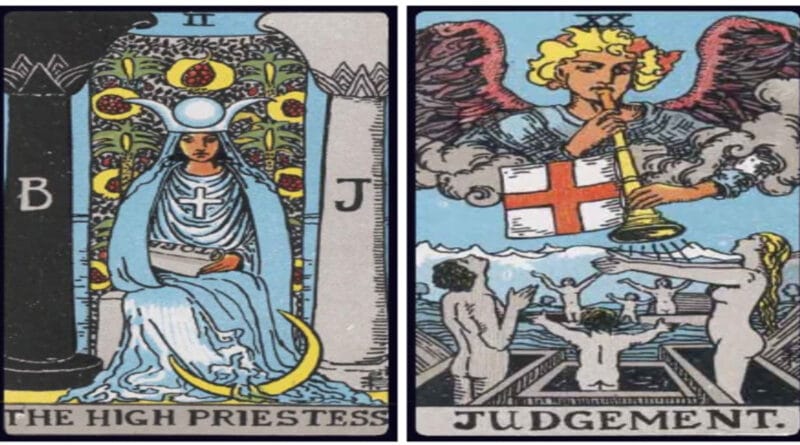
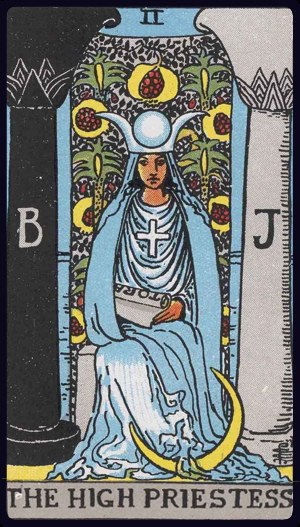
In the Rider-Waite-Smith deck, The High Priestess sits between two pillars marked B and J, in front of a veil decorated with pomegranates. A crescent moon rests at her feet, and a scroll half-hidden in her lap hints at knowledge she holds but does not fully reveal. She is the card of intuition, the subconscious and quiet wisdom.
So what is she trying to tell you? Usually this: you know more than you think, and the answer may arrive when you stop asking everyone else. As a birth card, she invites you to trust your inner voice and to protect your privacy without hiding from life.
Judgement (#20): what does this tarot card mean?
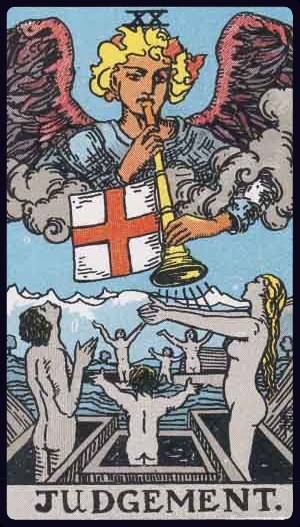
Judgement shows an angel sounding a trumpet over people rising from their coffins with open arms. It is a card of awakening, self-reflection, forgiveness and answering a calling. Despite the name, it is less about being judged by others and more about a moment of honest recognition: seeing your life clearly and deciding how to respond.
As a birth card, Judgement points to a life shaped by purpose, turning points and second chances. It asks you to let go of old stories and to answer the part of you that keeps calling.
The High Priestess and Judgement combination in tarot
Together, these cards describe a person who listens first and answers later. The High Priestess holds the secret; Judgement sounds the horn. What she senses in silence, the angel invites you to bring into the open.
What is the difference between Judgement and The High Priestess?
The main difference is direction. The High Priestess turns inward: she waits, watches and gathers understanding. Judgement turns outward: it declares, acts and answers. One is the whisper before a decision, the other is the trumpet after it. Some readers also see a numerical echo, since Judgement (20) is built from the 2 of The High Priestess and a 0 that suggests a cycle carried through to its end.
What does the High Priestess and Judgement pairing symbolize?
Symbolically, the pair is about hidden knowledge becoming visible. Both cards deal with what lies beneath the surface: hers is a veiled inner world, his is a graveyard where buried things rise. Together they represent the journey from private knowing to public purpose.
The gifts of The High Priestess and Judgement
1. An inner compass
You often sense what is right for you before you can prove it. This quiet certainty helps you choose paths and people that fit, even when the reasons take time to become clear.
2. Timely awakening
You can recognize when a chapter of life is asking for a bold answer. That sense of timing lets you make meaningful changes at moments when others are still hesitating.
3. Persuasive authenticity
Because you don’t speak carelessly, your words carry weight. When you finally share what you believe, your calm certainty makes people listen.
The challenges of The High Priestess and Judgement
1. Sitting on your calling
You may wait until you feel completely ready, and the moment passes. The High Priestess can turn patience into delay when nothing is ever quite certain enough to begin.
2. Seeking permission
Needing approval before you act can silence your own signal. If you keep asking others whether your path is valid, you may talk yourself out of the very thing that feels most true.
3. Harsh self-review
High standards around your purpose can turn into constant self-criticism. Judgement is meant to be a moment of clear seeing, not a permanent trial.
How to work with The High Priestess and Judgement
1. Act on a small call
Take one small step in the direction your intuition keeps pointing: a message, a first page, a conversation. Small actions turn quiet knowing into real momentum.
2. Choose your audience
You don’t have to share everything with everyone. Decide who has earned your story and tell them first. Being selective protects your privacy while still letting you be seen.
3. Replace judgment with review
When you look back on a decision, ask “What did I learn?” instead of “What did I do wrong?” This keeps Judgement working as a source of growth rather than blame.
The High Priestess and Judgement in love
As birth cards, this pair loves deeply and often privately. You may take time to open up, but once you do, you want honesty and meaning more than surface excitement. Your challenge in relationships is to say what you feel rather than hoping a partner will sense it. A helpful habit is to share one honest feeling with someone you trust each week, small and simple, so intimacy grows through words as well as instinct.
The High Priestess and Judgement as feelings in a reading
When these two cards appear in a tarot reading about feelings, readers often interpret them as deep emotions that haven’t been fully spoken, along with a moment of realization drawing near. Treat this as an invitation for reflection or an honest conversation, not a guarantee of what another person feels. Only they can tell you that.
The High Priestess and Judgement life path
This pair suggests a path in which inner listening leads to a calling. People with it are often drawn to work and roles that involve guidance, healing, writing, research or advocacy, anywhere depth and honest expression matter. Your life path is likely to include a turning point when something you have long known quietly becomes something you act on.
How do you get The High Priestess and Judgement as birth cards?
You receive this pair when your birth date calculation reaches 20. Add your month, day, the first two digits of your birth year and the last two digits of your year. If the total is a three-digit number, add its first two digits to its third digit.
Example 1 (06/11/1992): 6 + 11 + 19 + 92 = 128, then 12 + 8 = 20. Your first card is Judgement (20), and 2 + 0 gives The High Priestess (2).
Example 2 (05/15/1980): 5 + 15 + 19 + 80 = 119, then 11 + 9 = 20, giving the same pair.
The quickest way to check is to enter your birthday in the free tarot birth card calculator.
Frequently asked questions
What does the combination of Judgement and The High Priestess mean in tarot?
Together they describe listening to your intuition and then answering a calling. The High Priestess represents quiet inner knowing, while Judgement represents awakening and acting on what you know.
What does it mean to have The High Priestess and Judgement as birth cards?
It suggests a life path shaped by intuition and purpose. You learn when to protect your inner world and when to step forward and share what you know.
What is the difference between Judgement and The High Priestess?
The High Priestess turns inward to observe and gather understanding, while Judgement turns outward to declare and act. One is the whisper before a decision, the other the trumpet after it.
What is The High Priestess trying to tell me?
Often that you already know more than you give yourself credit for. She encourages you to trust your instincts and to pause before seeking outside opinions.
What does the Judgement tarot card mean?
Judgement represents awakening, self-reflection, forgiveness and answering a calling. It is about honest recognition of your life and choosing how to respond.
What do The High Priestess and Judgement mean as feelings?
In a reading about feelings, they can point to deep, unspoken emotions and a coming realization. Use this as a prompt for reflection or conversation, not as proof of what someone feels.
Are The High Priestess and Justice the same birth cards as The High Priestess and Judgement?
No. Both Justice (11) and Judgement (20) reduce to 2, so each pairs with The High Priestess, but they form two different birth card pairs. Read about The High Priestess and Justice birth cards.
Explore more tarot birth cards
This page is part of our tarot birth card calculator guide. If you haven’t found your cards yet, calculate your tarot birth cards from your date of birth, then browse the complete list of tarot birth card combinations to see how every pair compares.
Related birth card meanings
- The High Priestess and Justice birth cards: the same High Priestess, paired with fairness and truth
- The Hermit and The Moon birth cards: solitude, dreams and inner guidance
- Strength and The Star birth cards: quiet courage and renewal
Previous: The Hermit and The Moon birth cards | Next: The Empress and The World birth cards
More from Horoscopebuz
- Tarot readings and card meanings
- Tarot cards and zodiac signs: which sign each card belongs to
Tarot birth cards are a tool for reflection and entertainment, not a prediction of the future or a substitute for professional advice.