
The High Priestess and Justice Birth Cards: Meaning and Guide
If The High Priestess and Justice are your tarot birth cards, your path is about bringing two kinds of truth into agreement: what you feel and what you can prove. This pairing joins quiet intuition with clear, fair-minded judgment. Below you’ll find what the two cards mean together, how they compare, the gifts and challenges of the pair, how it may show up in love, what changes when they appear reversed, and ways to work with them.
Meet The High Priestess and Justice
- Keywords: intuition, mystery, inner wisdom, truth, fairness, accountability
- Gifts: trustworthy instincts, calm objectivity, deep discernment
- Challenges: analysis paralysis, hidden verdicts, a spotless standard
- Advice: name the feeling then check the facts, say your verdict out loud, allow gray areas
Not sure these are your cards? Use our free tarot birth card calculator to find your birth cards from your date of birth.
What does the Justice and High Priestess birth card mean?
Having these two as birth cards suggests a life path centered on discernment. The High Priestess (2) represents intuition, privacy and depth. Justice (11) represents truth, cause and effect, and fair decisions. The two are connected by number: 11 reduces to 2 (1 + 1), which is why they arrive as a pair.
Your first card, Justice, tends to describe how you meet the world: weighing, questioning, wanting things to be fair. Your second card, The High Priestess, describes what lies underneath: an inner voice that senses truth before it can explain it. People with this pair often make careful choices and are the ones friends ask for honest, balanced advice.
The High Priestess (#2): the card of inner knowing
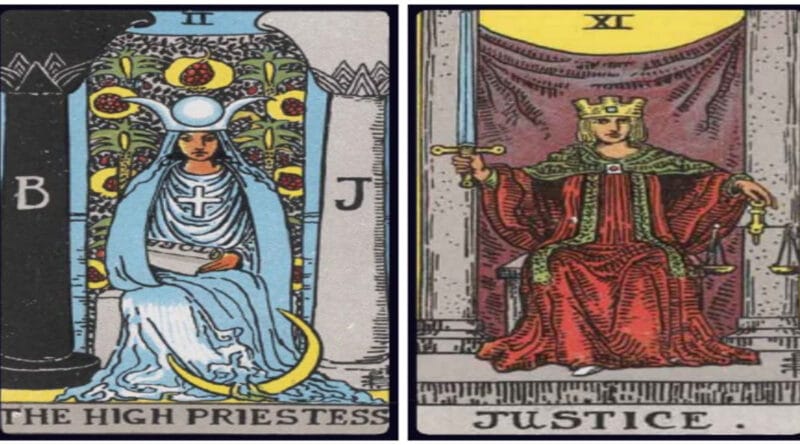
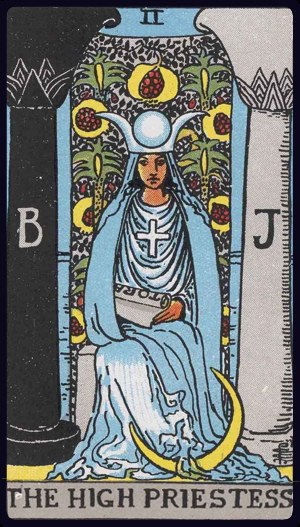
The High Priestess sits in a hush between two pillars, with a veil of pomegranates behind her and a crescent moon at her feet. A scroll rests partly hidden in her lap. She is the card of intuition, the subconscious and things understood without being said.
Her message is usually to slow down and listen. She isn’t a card of quick answers: she rewards patience and the willingness to sit with what you already sense. As a birth card, she gives you a strong inner compass and a need for privacy and reflection.
Justice (#11): what does this tarot card mean?
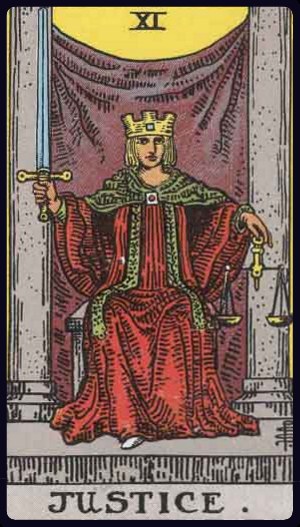
In the Rider-Waite-Smith deck, Justice is the eleventh Major Arcana card. (Marseille-style decks number it 8 and swap it with Strength, so check your own deck.) She sits upright in a red robe, holding a raised sword in one hand and balanced scales in the other. The card is about truth, fairness, accountability and consequences: what you do shapes what returns to you.
Which zodiac sign represents Justice? In the Golden Dawn tradition, which many modern decks follow, Justice is linked to Libra, the sign of balance. That connection is a convention rather than a rule, and some decks and readers use different correspondences.
Is Justice a positive card? Generally it reads as neutral to positive. It is affirming when you are acting honestly and fairly, and challenging when you are avoiding responsibility. Its core message is that clarity and honest choices lead to outcomes you can stand behind.
The High Priestess and Justice combination in tarot
Together these cards describe inner truth and outer truth working in step. The High Priestess senses what is real; Justice checks it, names it and acts on it. The pair supports decisions that feel right and can also be defended, and it highlights honesty, accountability and thoughtful choices.
Similarities between The High Priestess and Justice
The two cards are visually related. In the Rider-Waite-Smith deck, both show a seated, forward-facing figure placed between two pillars, with a curtain or veil hanging behind. Both are cards about seeing clearly and about standing between two sides of something.
Differences between The High Priestess and Justice
Their moods differ. The High Priestess sits in a cool, quiet setting with a closed, still posture, and she guards what she knows. Justice sits in bold color with an open, direct posture, sword and scales in hand, and she speaks it plainly. One holds a mystery; the other delivers a verdict. In short: she feels the truth, Justice weighs it.
The gifts of The High Priestess and Justice
1. Trustworthy instincts
Your gut feelings tend to point somewhere real, and you can often back them up with evidence. This makes your intuition easier for you and others to trust.
2. Calm objectivity
People find you fair because you weigh situations without rushing to take sides. Your steadiness helps others feel heard.
3. Deep discernment
You notice what is left unsaid in a conversation and what a decision will cost later. That foresight helps you avoid choices that look good but feel off.
The challenges of The High Priestess and Justice
1. Analysis paralysis
Wanting both a felt sense and solid proof can leave you unable to commit. You may keep gathering information long after you know what you’d choose.
2. Hidden verdicts
You may quietly judge people or choices without sharing your reasoning. Others can be left guessing, or feel evaluated without knowing why.
3. A spotless standard
Your strong sense of fairness can turn inward as perfectionism and guilt. Justice is meant to weigh with balance, and that includes weighing yourself kindly.
How to work with The High Priestess and Justice
1. Name the feeling, then check the facts
Write down your first intuition, list what you know, and compare the two before deciding. Let each voice speak before either wins.
2. Say your verdict out loud
Share your reasoning with someone you trust so fairness doesn’t stay locked inside. Spoken honestly and kindly, your judgment becomes a gift instead of a private verdict.
3. Allow gray areas
Some situations resist neat answers. Practice choosing well without perfect certainty, trusting that a thoughtful decision is enough.
The High Priestess and Justice in love
In a love reading, this pair points to a relationship guided by honesty and fairness. The High Priestess adds emotional wisdom and depth, while Justice brings clear communication and balance. It supports a respectful bond where both people feel seen and are accountable to each other.
As birth cards, you want love that is truthful, and you tend to notice when something is off before anyone says it. Your growth edge is to voice what you sense instead of quietly keeping score. A simple habit helps: when something bothers you, describe the feeling first, then the fact, and invite a conversation.
What does the Justice card mean in a love reading?
Justice in love generally signals honesty, fairness, commitment and consequences. It can point to a partnership built on balance, or ask you to address something that has been left unspoken so the relationship can rest on truth.
The High Priestess and Justice as feelings
When these cards appear together in a reading about someone’s feelings, readers often interpret thoughtful, sincere emotions that are well considered rather than impulsive. There may be a lot beneath the surface, along with a desire to be honest and fair. Treat this as a prompt for reflection or a clear conversation, not proof of what another person feels.
The High Priestess and Justice reversed
Reversed, the message tends to shift toward imbalance. The High Priestess reversed can suggest ignoring your intuition, staying on the surface, or secrets coming to light. Justice reversed can suggest unfairness, dodging accountability or a decision made without all the facts.
Together, reversed, they can describe a moment when your gut and your logic disagree and you are avoiding both. The invitation is the same as upright: slow down, be honest with yourself, and let feeling and fact meet.
The High Priestess and Justice in career and money
In work and money readings, the pair supports clear decision-making. The High Priestess helps you sense the right direction, and Justice adds logic, fair agreements and accountability. It favors ethical choices, reading contracts carefully and giving your instincts time before you sign.
How do you get The High Priestess and Justice as birth cards?
You receive this pair when your birth date calculation reaches 11. Add your month, day, the first two digits of your birth year and the last two digits of your year. For a two-digit total, add its digits. For a three-digit total, add the first two digits to the third digit.
Example 1 (06/16/1960): 6 + 16 + 19 + 60 = 101, then 10 + 1 = 11. Your first card is Justice (11), and 1 + 1 gives The High Priestess (2).
Example 2 (02/01/2006): 2 + 1 + 20 + 6 = 29, then 2 + 9 = 11, giving the same pair.
The quickest way to check is to enter your birthday in the free tarot birth card calculator.
Frequently asked questions
What does the Justice and High Priestess birth card mean?
It suggests a life path built on discernment: trusting your intuition and checking it against the facts. You are learning to balance inner knowing with fair, honest judgment.
What does the combination of the High Priestess and Justice tarot cards mean?
Together they show inner truth and outer truth working in step. The High Priestess senses what is real, and Justice weighs it and acts with fairness.
Which tarot card represents Justice?
Justice is Major Arcana card number 11 in the Rider-Waite-Smith deck. Marseille-style decks number it 8, so the number depends on the deck.
Which zodiac represents Justice?
Justice is traditionally linked to Libra, the sign of balance, in the Golden Dawn tradition. Some decks and readers use other correspondences.
What does the Justice card mean in a love reading?
It generally signals honesty, fairness, commitment and consequences, and can ask you to address what has been left unsaid.
Is the High Priestess a yes or no love card?
Many readers treat her as a “not yet” or “wait and listen” card rather than a clear yes or no, since she points to something still unfolding beneath the surface.
Is the Justice card a positive card?
Generally neutral to positive. It is affirming when you act honestly and fairly, and challenging when you avoid responsibility.
What do the High Priestess and Justice mean as feelings?
Readers often interpret sincere, thoughtful emotions that are well considered. Use this as a prompt for reflection, not as proof of what someone feels.
What do the High Priestess and Justice mean reversed?
Reversed, they often point to imbalance: ignored intuition, avoided accountability or a decision made without all the facts.
Are The High Priestess and Judgement the same birth cards as The High Priestess and Justice?
No. Both Justice (11) and Judgement (20) reduce to 2, so each pairs with The High Priestess, but they form different birth card pairs. Read about The High Priestess and Judgement birth cards.
Explore more tarot birth cards
This page is part of our tarot birth card calculator guide. If you haven’t found your cards yet, calculate your tarot birth cards from your date of birth, then browse the complete list of tarot birth card combinations to see how every pair compares.
Related birth card meanings
- The High Priestess and Judgement birth cards: the same High Priestess, paired with awakening instead of fairness
- The Hermit and The Moon birth cards: more inner wisdom, intuition and reflection
- The Hierophant and Temperance birth cards: balance, values and calm judgment
Previous: The Magician and The Wheel of Fortune birth cards | Next: The Empress and The Hanged Man birth cards
More from Horoscopebuz
- Tarot readings and card meanings
- Libra (Justice): Libra zodiac sign guide and Libra horoscope dates
- Tarot cards and zodiac signs: which sign each card belongs to
Tarot birth cards are a tool for reflection and entertainment, not a prediction of the future or a substitute for professional advice.