
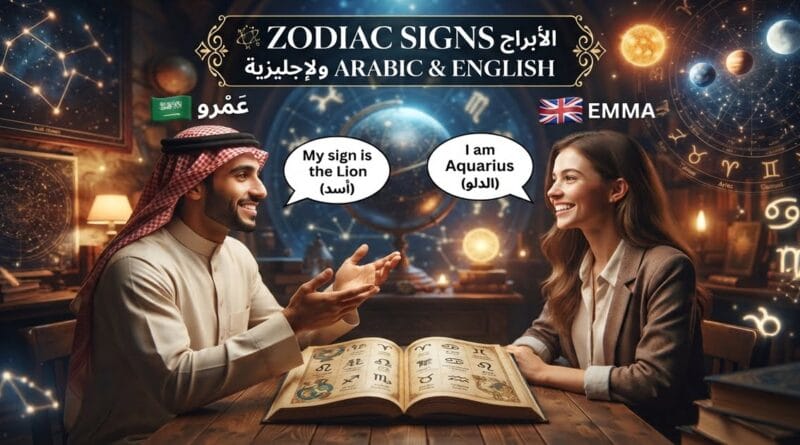
All 12 Zodiac Signs in Arabic: Complete Script, Transliteration & Audio Pronunciation Guide
Want to know how to say all zodiac signs in Arabic? This complete guide covers every sign from Aries in Arabic (برج الحمل) to Pisces in Arabic (برج الحوت) with Arabic script, transliteration, literal meaning, date ranges, and audio pronunciation for each.
Discover the two Virgo names (العذراء and السنبلة), understand moon vs. sun letter grammar rules, and learn regional differences between Egyptian, Gulf, and Levantine Arabic zodiac names.
Quick Summary: The 12 Zodiac Signs in Arabic
- Aries: الحمل (al-ḥamal)
- Taurus: الثور (at-thawr)
- Gemini: الجوزاء (al-jawzā’)
- Cancer: السرطان (as-saraṭān)
- Leo: الأسد (al-asad)
- Virgo: العذراء (al-‘adhrā’) or السنبلة (as-sunbulah)
- Libra: الميزان (al-mīzān)
- Scorpio: العقرب (al-‘aqrab)
- Sagittarius: القوس (al-qaws)
- Capricorn: الجدي (al-jady)
- Aquarius: الدلو (ad-dalw)
- Pisces: الحوت (al-ḥūt)
Note: A single zodiac sign in Arabic is called a burj (برج), and plural signs are known as al-abrāj (الأبراج).
All 12 Zodiac Signs in Arabic: Complete Reference with Audio
| Sign | Arabic | Transliteration | Literal Meaning | Date Range | Listen |
|---|---|---|---|---|---|
| Aries | الحمل | al-ḥamal | the lamb / the ram | March 21 – April 19 | |
| Taurus | الثور | at-thawr | the ox / bull | April 20 – May 20 | |
| Gemini | الجوزاء | al-jawzā’ | the twins | May 21 – June 20 | |
| Cancer | السرطان | as-saraṭān | the crab | June 21 – July 22 | |
| Leo | الأسد | al-asad | the lion | July 23 – August 22 | |
| Virgo (modern) | العذراء | al-‘adhrā’ | the virgin | August 23 – September 22 | |
| Virgo (classical) | السنبلة | as-sunbulah | the ear of grain | August 23 – September 22 | |
| Libra | الميزان | al-mīzān | the scales | September 23 – October 22 | |
| Scorpio | العقرب | al-‘aqrab | the scorpion | October 23 – November 21 | |
| Sagittarius | القوس | al-qaws | the archer / bow | November 22 – December 21 | |
| Capricorn | الجدي | al-jady | the goat | December 22 – January 19 | |
| Aquarius | الدلو | ad-dalw | the water-bearer | January 20 – February 18 | |
| Pisces | الحوت | al-ḥūt | the fish | February 19 – March 20 | |
| Zodiac sign (burj) | برج | burj | tower / fortress / sign | — |
- Aries in Arabic
- Taurus in Arabic
- Gemini in Arabic
- Cancer in Arabic
- Leo in Arabic
- Virgo in Arabic
- Libra in Arabic
- Scorpio in Arabic
- Sagittarius in Arabic
- Capricorn in Arabic
- Aquarius in Arabic
- Pisces in Arabic
Arabic Zodiac Signs Pronunciation Audio Transcripts & Downloads
Below are the pronunciation transcripts and download links for each zodiac sign in Arabic. Use these to practice offline, share with students, or reference while learning.
Aries in Arabic
الحمل
Transliteration: al-ḥamal
Phonetic: "al-HAM-al" (emphasis on second syllable)
⬇ Download MP3Taurus in Arabic
الثور
Transliteration: at-thawr
Phonetic: "at-THAWR" (th as in "think")
⬇ Download MP3Gemini in Arabic
الجوزاء
Transliteration: al-jawzā’
Phonetic: "al-jaw-ZAA" (emphasis on last syllable)
⬇ Download MP3Cancer in Arabic
السرطان
Transliteration: as-saraṭān
Phonetic: "as-sa-ra-TAAN" (emphasis on last syllable)
⬇ Download MP3Leo in Arabic
الأسد
Transliteration: al-asad
Phonetic: "al-a-SAD" (emphasis on last syllable)
⬇ Download MP3Virgo (Modern) in Arabic
العذراء
Transliteration: al-‘adhrā’
Phonetic: "al-adh-RAA" (emphasis on last syllable)
⬇ Download MP3Virgo (Classical) in Arabic
السنبلة
Transliteration: as-sunbulah
Phonetic: "as-sun-BU-lah" (emphasis on third syllable)
⬇ Download MP3Libra in Arabic
الميزان
Transliteration: al-mīzān
Phonetic: "al-mee-ZAAN" (emphasis on last syllable)
⬇ Download MP3Scorpio in Arabic
العقرب
Transliteration: al-‘aqrab
Phonetic: "al-AQ-rab" (emphasis on second syllable)
⬇ Download MP3Sagittarius in Arabic
القوس
Transliteration: al-qaws
Phonetic: "al-QAWS" (rhymes with "house")
⬇ Download MP3Capricorn in Arabic
الجدي
Transliteration: al-jady
Phonetic: "al-JAD-ee" (emphasis on second syllable)
⬇ Download MP3Aquarius in Arabic
الدلو
Transliteration: ad-dalw
Phonetic: "ad-DALW" (rhymes with "crawl")
⬇ Download MP3Pisces in Arabic
الحوت
Transliteration: al-ḥūt
Phonetic: "al-HOOT" (rhymes with "boot")
⬇ Download MP3Burj (Zodiac Sign) in Arabic
برج
Transliteration: burj
Phonetic: "BURJ" (rhymes with "merge")
⬇ Download MP3What Does “Burj” Mean in Arabic? Etymology, History & Cultural Context
The Arabic word burj (برج) literally means “tower,” “fortress,” or “bastion.” In classical Arabic, it referred to any tall, fortified structure — a watchtower on a city wall, a citadel, or a fortified palace.
From Fortress to Zodiac Sign
How did a word for “tower” become the word for “zodiac sign”? The connection is astronomical:
- In medieval Arabic astronomy, the ecliptic (the Sun’s apparent path) was divided into 12 “mansions” or “stations.”
- Each station was envisioned as a “tower” (burj) where the Sun “resided” for roughly a month.
- Over time, burj shifted from “the tower where the Sun stays” to simply “the zodiac sign itself.”
So when an Arabic speaker says برج الحمل (burj al-ḥamal), they’re literally saying “the Tower of the Lamb” — the celestial “fortress” occupied by Aries.
Famous Modern Uses of “Burj”
- Burj Khalifa (برج خليفة) — “Khalifa’s Tower,” the world’s tallest building (Dubai).
- Burj Al Arab (برج العرب) — “Tower of the Arabs,” iconic sail-shaped hotel (Dubai).
- Burj Al-Malik (برج الملك) — “King’s Tower,” historical citadels across the Levant.
- Burj al-Asad (برج الأسد) — “Tower of the Lion,” the Arabic name for the Leo zodiac sign.
Plural Forms & Related Terms
| Form | Arabic | Meaning |
|---|---|---|
| Singular | برج | tower / zodiac sign |
| Plural | أبراج (al-abrāj) | towers / zodiac signs |
| Diminutive | بريج (burayj) | small tower / outpost |
| Adjective | برجي (burjī) | zodiacal / astral |
Cultural Context: “Burj” in Daily Life
In the Arab world, asking “What’s your burj?” (ما برجك؟) is as common as asking “What’s your sign?” in English. It appears in:
- Newspaper horoscope columns: أبراج اليوم (al-abrāj al-yawm — “today’s zodiac signs”)
- Casual conversation: برجي الأسد (burjī al-asad — “my sign is Leo”)
- Traditional agriculture: farmers historically tracked al-abrāj for planting seasons
- Classical poetry: references to burj al-jawzā' (Gemini) as a seasonal marker
💡 Fun Fact: The English word “budget” comes from Old French bougette (“little bag”), which traces back to Latin bulga (“leather bag”) — unrelated to burj. But “borough” and “burg” (as in Pittsburgh, Hamburg) share the same Proto-Indo-European root *bʰergʰ- (“high, fortress”) as Arabic burj via Aramaic and Greek intermediaries.
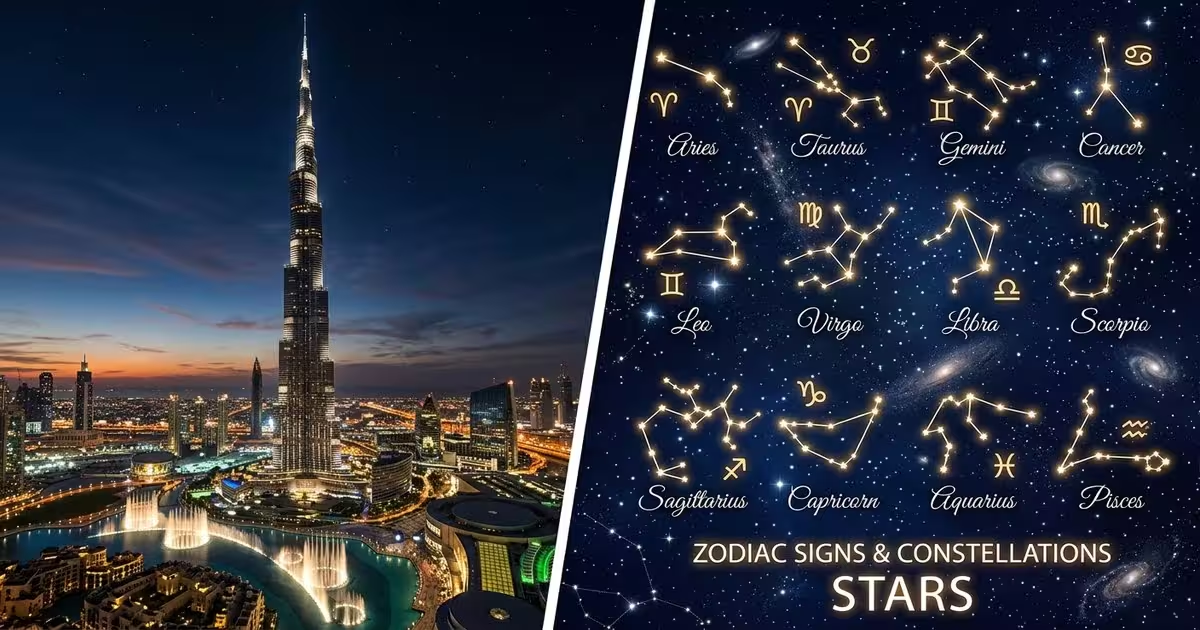
Burj Name List: Arabic, Urdu & Hindi Side by Side — Script, Transliteration & Pronunciation Guide
While Arabic is the liturgical language of the zodiac across the Muslim world, Urdu and Hindi speakers in South Asia use the same zodiac system with distinct scripts and subtle pronunciation shifts. This table maps all 12 signs across the three languages.
Key Differences: Arabic vs. Urdu Pronunciation
- Definite article: Arabic uses al- (الـ); Urdu often drops it or merges it (e.g., al-ḥamal → hamal).
- Phonemes: Urdu lacks the emphatic consonants ṣ, ḍ, ṭ, ẓ — these become plain s, d, t, z (e.g., as-saraṭān → saraṭān).
- Vowels: Urdu realizes long ā as ā or e in some dialects; ū may become o.
- Loan adaptations: Some signs use Persian-derived names in Urdu (e.g., burj-e-ḥamal vs. Arabic burj al-ḥamal).
Hindi Notes
Hindi uses Devanagari script and Sanskritized vocabulary. Many signs use native Sanskrit terms (Meṣa for Aries, Vṛṣabha for Taurus) alongside Perso-Arabic loans (Burj Hamal, Burj Saur). Both are shown below.
| # | English | Arabic (Standard) | Urdu (Arabic Script) | Urdu (Roman) | Hindi (Devanagari) | Hindi (Roman) |
|---|---|---|---|---|---|---|
| 1 | Aries | الحملal-ḥamal | حمل | hamal | मेष | Meṣa |
| 2 | Taurus | الثورat-thawr | ثور | saur | वृषभ | Vṛṣabha |
| 3 | Gemini | الجوزاءal-jawzā’ | جوزا | jauzā | मिथुन | Mithuna |
| 4 | Cancer | السرطانas-saraṭān | سرطان | saraṭān | कर्क | Karka |
| 5 | Leo | الأسدal-asad | اسد | asad | सिंह | Siṃha |
| 6 | Virgo (modern) | العذراءal-‘adhrā’ | عذراء | adhrā | कन्या | Kanyā |
| 6a | Virgo (classical) | السنبلةas-sunbulah | سنبلہ | sunbalah | कन्या (शास्त्रीय) | Kanyā (śāstrīya) |
| 7 | Libra | الميزانal-mīzān | ميزان | mīzān | तुला | Tulā |
| 8 | Scorpio | العقربal-‘aqrab | عقرب | aqrab | वृश्चिक | Vṛścika |
| 9 | Sagittarius | القوسal-qaws | قوس | qaus | धनु | Dhanu |
| 10 | Capricorn | الجديal-jady | جدی | jadi | मकर | Makara |
| 11 | Aquarius | الدلوad-dalw | دلو | dalw | कुंभ | Kumbha |
| 12 | Pisces | الحوتal-ḥūt | حوت | ḥūt | मीन | Mīna |
Notes: Urdu Arabic script omits the definite article al-. Hindi column shows primary Sanskrit term; Perso-Arabic loans (e.g., Burj Hamal) are also used colloquially. Row 6a = classical Virgo name (as-sunbulah / sunbalah).
Arabic Zodiac Signs by Month — Egypt, Gulf & Levant Regional Variations
The zodiac signs themselves are the same across the Arab world, but month names differ by region. Egypt and the Gulf use Aramaic-derived names; the Levant uses Arabicized Latin names; the Maghreb uses French-influenced names; Iraq uses a hybrid system. Select a region above to filter the table.
| Zodiac Sign | Arabic Sign | Dates (Gregorian) | Egypt & Gulf | Levant | Maghreb | Iraq |
|---|---|---|---|---|---|---|
| Aries | الحمل | Mar 21 – Apr 19 | مارس – أبريلMāris – Abril | آذار – نيسانĀdhār – Nīsān | مارس – أبريلMāris – Abril | آذار – نيسانĀdhār – Nīsān |
| Taurus | الثور | Apr 20 – May 20 | أبريل – مايوAbril – Māyū | نيسان – أيارNīsān – Ayyār | أبريل – مايAbril – Māy | نيسان – أيارNīsān – Ayyār |
| Gemini | الجوزاء | May 21 – Jun 20 | مايو – يونيوMāyū – Yūnyū | أيار – حزيرانAyyār – Ḥazīrān | ماي – يونيوMāy – Yūnyū | أيار – حزيرانAyyār – Ḥazīrān |
| Cancer | السرطان | Jun 21 – Jul 22 | يونيو – يوليوYūnyū – Yūlyū | حزيران – تموزḤazīrān – Tammūz | يونيو – يوليوزYūnyū – Yūlyūz | حزيران – تموزḤazīrān – Tammūz |
| Leo | الأسد | Jul 23 – Aug 22 | يوليو – أغسطسYūlyū – Aghusṭus | تموز – آبTammūz – Āb | يوليوز – غشتYūlyūz – Ghusht | تموز – آبTammūz – Āb |
| Virgo | العذراء / السنبلة | Aug 23 – Sep 22 | أغسطس – سبتمبرAghusṭus – Sibtambar | آب – أيلولĀb – Aylūl | غشت – شتنبرGhusht – Shtambar | آب – أيلولĀb – Aylūl |
| Libra | الميزان | Sep 23 – Oct 22 | سبتمبر – أكتوبرSibtambar – Uktūbar | أيلول – تشرين الأولAylūl – Tishrīn al-Awwal | شتنبر – أكتوبرShtambar – Uktūbar | أيلول – تشرين الأولAylūl – Tishrīn al-Awwal |
| Scorpio | العقرب | Oct 23 – Nov 21 | أكتوبر – نوفمبرUktūbar – Nufambar | تشرين الأول – تشرين الثانيTishrīn al-Awwal – Tishrīn al-Thānī | أكتوبر – نونبرUktūbar – Nūnbar | تشرين الأول – تشرين الثانيTishrīn al-Awwal – Tishrīn al-Thānī |
| Sagittarius | القوس | Nov 22 – Dec 21 | نوفمبر – ديسمبرNufambar – Disambar | تشرين الثاني – كانون الأولTishrīn al-Thānī – Kānūn al-Awwal | نونبر – دجنبرNūnbar – Djanbar | تشرين الثاني – كانون الأولTishrīn al-Thānī – Kānūn al-Awwal |
| Capricorn | الجدي | Dec 22 – Jan 19 | ديسمبر – ينايرDisambar – Yanāyir | كانون الأول – كانون الثانيKānūn al-Awwal – Kānūn al-Thānī | دجنبر – ينايرDjanbar – Yanāyir | كانون الأول – كانون الثانيKānūn al-Awwal – Kānūn al-Thānī |
| Aquarius | الدلو | Jan 20 – Feb 18 | يناير – فبرايرYanāyir – Febrāyir | كانون الثاني – شباطKānūn al-Thānī – Shubāṭ | يناير – فبرايرYanāyir – Febrāyir | كانون الثاني – شباطKānūn al-Thānī – Shubāṭ |
| Pisces | الحوت | Feb 19 – Mar 20 | فبراير – مارسFebrāyir – Māris | شباط – آذارShubāṭ – Ādhār | فبراير – مارسFebrāyir – Māris | شباط – آذارShubāṭ – Ādhār |
Regional Naming Systems Explained
Egypt & Gulf (Aramaic-derived)
Uses Māris, Abril, Māyū, Yūnyū, Yūlyū, Aghusṭus, Sibtambar, Uktūbar, Nufambar, Disambar, Yanāyir, Febrāyir. Derived from Aramaic/Syriac calendar via Coptic influence. Standard in Saudi Arabia, UAE, Qatar, Kuwait, Bahrain, Oman, Egypt, Sudan.
Levant (Arabicized Latin)
Uses Ādhār, Nīsān, Ayyār, Ḥazīrān, Tammūz, Āb, Aylūl, Tishrīn, Kānūn, Shubāṭ. Direct Arabicizations of Latin month names (Martius → Ādhār, Aprilis → Nīsān). Standard in Syria, Lebanon, Jordan, Palestine.
Maghreb (French-influenced)
Uses Māris, Abril, Māy, Yūnyū, Yūlyūz, Ghusht, Shtambar, Uktūbar, Nūnbar, Djanbar, Yanāyir, Febrāyir. Heavily influenced by French colonial administration (Mars, Avril, Mai, Juin, Juillet, Août, Septembre, Octobre, Novembre, Décembre, Janvier, Février). Standard in Morocco, Algeria, Tunisia, Libya.
Iraq (Hybrid)
Uses Levantine names for spring/summer (Nīsān, Ayyār, Ḥazīrān, Tammūz, Āb, Aylūl) but switches to Aramaic-derived for autumn/winter (Tishrīn, Kānūn, Shubāṭ, Ādhār). Reflects historical Babylonian calendar layering.
The الـ That Changes Its Own Sound — Sun & Moon Letters in Arabic Zodiac Names
In Arabic, the definite article الـ (al-) behaves differently depending on the first letter of the word it attaches to. This is one of the most distinctive features of Arabic phonology — and it affects how you pronounce every zodiac sign name.
The Rule in Brief
- Moon Letters (الحروف القمرية): The lam (ل) is pronounced clearly. Example: القمر → al-qamar.
- Sun Letters (الحروف الشمسية): The lam assimilates (disappears) and the following consonant is doubled (shadda). Example: الشمس → ash-shams (not al-shams).
Why "Sun" and "Moon"?
The classic textbook example uses القمر (al-qamar, "the moon") and الشمس (ash-shams, "the sun"). Qāf is a moon letter; shīn is a sun letter. The mnemonic stuck.
The Complete Lists
Moon Letters (14)
أ ب ج ح خ ع غ ف ق ك م ه و ي
Hamza, Bā', Jīm, Ḥā', Khā', 'Ayn, Ghayn, Fā', Qāf, Kāf, Mīm, Hā', Wāw, Yā'
→ Lam pronounced: al-
Sun Letters (14)
ت ث د ذ ر ز س ش ص ض ط ظ ل ن
Tā', Thā', Dāl, Dhāl, Rā', Zāy, Sīn, Shīn, Ṣād, Ḍād, Ṭā', Ẓā', Lām, Nūn
→ Lam assimilated: a- + shadda on next letter
Zodiac Signs: Which Are Sun Letters?
Out of the 12 signs (+ Virgo classical + burj), 4 start with sun letters:
| Sign | Arabic | First Letter | Type | Pronunciation |
|---|---|---|---|---|
| Taurus | الثور | ث (Thā') | Sun | at-thawr (not al-thawr) |
| Cancer | السرطان | س (Sīn) | Sun | as-saraṭān (not al-saraṭān) |
| Virgo (classical) | السنبلة | س (Sīn) | Sun | as-sunbulah (not al-sunbulah) |
| Aquarius | الدلو | د (Dāl) | Sun | ad-dalw (not al-dalw) |
The other 9 signs (Aries, Gemini, Leo, Virgo modern, Libra, Scorpio, Sagittarius, Capricorn, Pisces) + burj are moon letters — their al- is fully pronounced.
Interactive Quiz: Test Your Sun/Moon Letter Knowledge
Click the correct classification for each zodiac sign. Your score updates live.
The Sign With Two Correct Arabic Names — Why Virgo Has Al-‘Adhrā’ and As-Sunbula
Virgo Is the Only Zodiac Sign With Two Standard Arabic Names
Every other sign has one agreed-upon Arabic name. Virgo has two — both correct, both widely used, and each with a distinct historical and astronomical origin.
al-‘adhrā’
“The Virgin”as-sunbula
“The Ear of Grain / Spike”Why Two Names? The Historical Astronomy
The constellation Virgo has been depicted for millennia as a woman holding a sheaf of wheat — the bright star Spica (السماك الأعزل, as-Simāk al-A‘zal) marks the grain in her hand. This visual gave rise to two naming traditions:
Tradition 1: The Figure — Al-‘Adhrā’
Origin: Greek Parthenos (Παρθένος) → Arabic al-‘adhrā’ (العذراء).
Focus: The maiden/virgin figure herself. This is the Ptolemaic/astrological tradition — naming the sign after the mythological figure.
Used in: Modern horoscopes, daily Arabic media, Western-style astrology in the Arab world.
Tradition 2: The Star — As-Sunbula
Origin: Arabic sunbula (سنبلة) = "ear of grain / spike of wheat." Directly references Spica (α Virginis), the constellation's brightest star.
Focus: The agricultural/astronomical marker. This is the indigenous Arabic/Babylonian tradition — naming the sign after its brightest star and seasonal significance (harvest time).
Used in: Classical Arabic astronomy texts (e.g., Kitāb al-Anwā’), traditional farming calendars, historical manuscripts.
The Spica Connection
Spica (α Virginis) = السماك الأعزل (as-Simāk al-A‘zal) — "The Unarmed Simāk."
In Arabic astronomy, Simāk refers to two bright stars: Simāk al-Rāmiḥ (Arcturus, "the Armed Simāk") and Simāk al-A‘zal (Spica, "the Unarmed Simāk"). Spica's position in the "hand" of Virgo, holding the grain, is exactly why al-sunbula became a name for the entire sign.
💡 Astronomical Fact: Spica is a spectroscopic binary — two stars orbiting each other every 4 days. Its name comes from Latin spīca virginis ("Virgo's ear of grain"), a direct calque of the Arabic sunbula.
Regional Usage Today
| Region / Context | Preferred Name | Notes |
|---|---|---|
| Modern Arabic horoscopes (Egypt, Gulf, Levant) | العذراء (al-‘adhrā’) | Standard in media, apps, daily columns |
| Classical astronomy texts / manuscripts | السنبلة (as-sunbula) | Found in Kitāb al-Anwā’, Zij al-Sindhind |
| Traditional farming calendars (Levant, Iraq) | السنبلة or both | Linked to harvest season timing |
| North Africa (Maghreb) | العذراء | French-influenced media uses la Vierge |
| South Asia (Urdu/Hindi) | عذراء / कन्या | Sanskrit Kanyā = "maiden"; Urdu drops al- |
Why This Matters for Learners
- If you search "Virgo in Arabic," you'll find both — don't be confused.
- Modern apps/horoscopes: use al-‘adhrā’ (العذراء).
- Classical texts, poetry, farming almanacs: expect as-sunbula (السنبلة).
- Both are 100% correct — they just come from different traditions (figure vs. star).
🎯 Pro Tip for Arabic Learners
Use this as a grammar twofer:
- Al-‘adhrā’ (العذراء) → Moon letter (‘ayn) →
al-‘adhrā’(lam pronounced) - As-sunbula (السنبلة) → Sun letter (sīn) →
as-sunbula(lam assimilates)
Same sign, two names, both sun/moon letter rules demonstrated.
Historical Context — How the Zodiac Traveled: Greek → Arabic → European Astronomy
The zodiac signs we use today are the product of a 2,000-year relay across civilizations. Each culture preserved, translated, and enriched the system before passing it forward.
c. 1000–500 BCE — Babylonian Foundations
The Babylonians divided the ecliptic into 12 equal 30° segments, each linked to a constellation. They created the first zodiacal calendar for agricultural and omen purposes. Key stars: Hamal (Aries), Aldebaran (Taurus), Spica (Virgo).
c. 300–150 BCE — Greek Systematization
Hipparchus and Ptolemy (in the Almagest) formalized the tropical zodiac — tying signs to equinoxes/solstices, not fixed stars. They gave us the Greek names: Krios (Aries), Tauros (Taurus), Parthenos (Virgo).
8th–10th Century CE — The Arabic Translation Movement
In Baghdad's Bayt al-Ḥikma (House of Wisdom), scholars translated Ptolemy's Almagest into Arabic. They didn't just translate — they corrected star positions, added new observations, and Arabicized the terminology.
- Ḥunayn ibn Isḥāq — master translator, standardized astronomical vocabulary
- Al-Battānī — refined solar year, updated star coordinates
- Al-Ṣūfī — authored Kitāb Ṣuwar al-Kawākib (Book of Fixed Stars), the definitive Arabic star atlas
This is where al-Ḥamal, at-Thawr, al-Jawzā' became fixed as the Arabic zodiac names.
10th–13th Century — Al-Andalus & Latin Translations
In Toledo, Córdoba, and Sicily, Arabic texts were translated into Latin. European scholars regained Ptolemy — but through Arabic eyes. The Arabic star names entered European astronomy:
- Almagest → Latin (Gerard of Cremona, 1175)
- Zij al-Sindhind → Latin astronomical tables
- Arabic star names became the standard proper names for bright stars
16th Century Onward — IAU Standardization
The International Astronomical Union (IAU) formalized 88 constellations and approved official star names in 2016. Over 200 approved star names are of Arabic origin — a direct legacy of the medieval translation chain.
The Translation Chain: A Case Study
Key Figures in the Arabic Link
Al-Ṣūfī (903–986)
Kitāb Ṣuwar al-Kawākib — illustrated star atlas with Arabic bedouin star names alongside Ptolemaic constellations. Source for many modern star names.
Al-Bīrūnī (973–1048)
Computed precise coordinates for zodiacal stars; wrote Kitāb al-Tafhīm explaining astronomical terms in Arabic and Persian.
Ibn al-Shāṭir (1304–1375)
Developed planetary models that anticipated Copernicus; his zodiacal tables used in Damascus mosques for prayer times.
Ulugh Beg (1394–1449)
Zij-i Sultānī — star catalog with positions accurate to seconds of arc; included Arabic star names for all zodiacal bright stars.
Arabic Star Names in English — The Complete Legacy: 30+ Stars You Already Know
When you say Betelgeuse, Rigel, Aldebaran, Vega, Deneb, Altair, Fomalhaut — you're speaking Arabic. Over 200 IAU-approved star names derive from Arabic. Below are the most famous zodiacal and navigational stars with their Arabic origins.
Zodiacal Bright Stars (The Sign Markers)
| English Name | Arabic Origin | Literal Meaning | Constellation / Zodiac Sign |
|---|---|---|---|
| Hamal | رأس الحمل (ra's al-ḥamal) | Head of the Lamb | Aries (α Arietis) |
| Aldebaran | الدبران (ad-dabarān) | The Follower (of the Pleiades) | Taurus (α Tauri) |
| Rigel | رجل الجبار (rijl al-jabbār) | Foot of the Giant (Orion) | Orion (β Orionis) — near Taurus/Gemini boundary |
| Betelgeuse | إبط الجوزاء (ibṭ al-jawzā') | Armpit of the Central One (Gemini/Orion) | Orion (α Orionis) — near Gemini |
| Castor | رأس التوأم (ra's al-taw'am) | Head of the Twin | Gemini (α Geminorum) |
| Pollux | رأس التوأم المؤخر (ra's al-taw'am al-mu'akhkhar) | Head of the Rear Twin | Gemini (β Geminorum) |
| Regulus | قلب الأسد (qalb al-asad) | Heart of the Lion | Leo (α Leonis) |
| Spica | السماك الأعزل (as-simāk al-a'zal) | The Unarmed Simāk | Virgo (α Virginis) |
| Zubenelgenubi | الزنبلي الجنوبي (az-zubān al-janūbī) | Southern Claw (of Scorpio) | Libra (α Librae) |
| Zubeneschamali | الزنبلي الشمالي (az-zubān al-shamālī) | Northern Claw (of Scorpio) | Libra (β Librae) |
| Antares | قلب العقرب (qalb al-'aqrab) | Heart of the Scorpion | Scorpio (α Scorpii) |
| Shaula | الشولة (ash-shawla) | The Raised Tail / Sting | Scorpio (λ Scorpii) |
| Kaus Australis | القوس الجنوبي (al-qaws al-janūbī) | Southern Part of the Bow | Sagittarius (ε Sagittarii) |
| Dabih | الذابح (ad-dābiḥ) | The Slaughterer / Butcher | Capricorn (β Capricorni) |
| Sadalmelik | سعد الملك (sa'd al-malik) | Lucky Star of the King | Aquarius (α Aquarii) |
| Sadalsuud | سعد السعود (sa'd al-su'ud) | Luckiest of the Lucky | Aquarius (β Aquarii) |
| Fomalhaut | فم الحوت (fam al-ḥūt) | Mouth of the Fish | Pisces (α Piscis Austrini) |
| English Name | Arabic Origin | Literal Meaning | Constellation |
|---|---|---|---|
| Vega | النسر الواقع (an-nasr al-wāqi') | The Falling Eagle / Swooping Vulture | Lyra |
| Altair | النسر الطائر (an-nasr aṭ-ṭā'ir) | The Flying Eagle | Aquila |
| Deneb | الذنب (adh-dhanab) | The Tail (of the Hen) | Cygnus |
| Arcturus | السماك الرامح (as-simāk ar-rāmiḥ) | The Armed Simāk (Lance-Bearer) | Boötes |
| Achernar | آخر النهر (ākhir an-nahr) | End of the River | Eridanus |
| Algol | الغول (al-ghūl) | The Ghoul / Demon Star | Perseus |
| Alphard | الفرد (al-fard) | The Solitary One | Hydra |
| Alioth | الألياء (al-alyā') | The Fat Tail (of a sheep) | Ursa Major |
| Mizar | المئزر (al-mi'zar) | The Waistband / Girdle | Ursa Major |
| Alcor | السها (as-suha) | The Forgotten / Neglected One | Ursa Major |
| Dubhe | الدب (ad-dubb) | The Bear | Ursa Major |
| Merak | المراق (al-mirāq) | The Loin (of the Bear) | Ursa Major |
| Phecda | فخذ الدب (fakhdh ad-dubb) | Thigh of the Bear | Ursa Major |
| Megrez | مغرض (maghraz) | The Base (of the Bear's Tail) | Ursa Major |
Arabic Naming Patterns — Decoding the Prefixes
Al- / Ad- / As- / Ar-
The definite article al- + sun letter assimilation. Most common prefix.
- Al-debaran → Aldebaran
- As-simāk → Spica's traditional name
- Ar-raqis (the dancer) → not used
Ra's (رأس)
"Head of" — marks the brightest/leading star in a figure.
- Ra's al-ḥamal → Hamal
- Ra's al-taw'am → Castor
- Ra's al-jawzā' → not directly used
Qalb (قلب)
"Heart of" — marks the central bright star.
- Qalb al-asad → Regulus
- Qalb al-'aqrab → Antares
Rijl / Yad / Dhanab / Fam
Body parts: Foot, Hand, Tail, Mouth.
- Rijl al-jabbār → Rigel
- Dhanab al-dajāja → Deneb
- Fam al-ḥūt → Fomalhaut
Sa'd (سعد)
"Lucky / Fortunate" — Arabic lunar mansion system (anwā').
- Sa'd al-malik → Sadalmelik
- Sa'd al-su'ud → Sadalsuud
- Sa'd al-bari' (not in IAU list)
Zubān / Janb / Kawkab
Claw, Side, Star — positional descriptors.
- Zubān al-janūbī → Zubenelgenubi
- Zubān al-shamālī → Zubeneschamali
Why This Matters
Every time you navigate by stars, read a star chart, or use a telescope app — you're using Arabic. The IAU's 2016 formalization of 313 proper star names cemented Arabic as the lingua franca of stellar nomenclature. This isn't trivia — it's the living legacy of the medieval Arabic translation movement that saved, refined, and transmitted the science of the stars to the modern world.
The Remaining Arabic Star Signs — Individual Deep-Dives & Pronunciation Guides
Below are dedicated deep-dive guides for each zodiac sign. Each page covers Arabic script, transliteration, literal meaning, pronunciation audio, grammar notes (sun/moon letter), regional variations, historical star names, and cultural context. Jump to any sign:
Aries in Arabic — الحمل (al-ḥamal)
- Arabic Script
- الحمل
- Transliteration
al-ḥamal- Literal Meaning
- The Lamb / The Ram
- Date Range
- March 21 – April 19
- First Letter
- Moon Letter (ح)
- Pronunciation
al-ḥamal— "al-HAM-al"
Audio Pronunciation
⬇ Download MP3Grammar Note
Ḥā' (ح) is a moon letter → the lam in al- is fully pronounced: al-ḥamal (not aḥ-ḥamal).
Bright Star: Hamal (α Arietis)
Arabic: رأس الحمل (ra's al-ḥamal) — "Head of the Lamb." Hamal (magnitude 2.0) is an orange giant 66 light-years away. The name comes directly from ra's al-ḥamal.
Regional Month Names
| Region | Months |
|---|---|
| Egypt/Gulf | مارس – أبريل (Māris – Abril) |
| Levant | آذار – نيسان (Ādhār – Nīsān) |
| Maghreb | مارس – أبريل (Māris – Abril) |
| Iraq | آذار – نيسان (Ādhār – Nīsān) |
Urdu / Hindi
Urdu: حمل (hamal) | Hindi: मेष (Meṣa)
Taurus in Arabic — الثور (at-thawr)
- Arabic Script
- الثور
- Transliteration
at-thawr- Literal Meaning
- The Ox / Bull
- Date Range
- April 20 – May 20
- First Letter
- Sun Letter (ث)
- Pronunciation
at-thawr— "at-THAWR"
Audio Pronunciation
⬇ Download MP3Grammar Note
Thā' (ث) is a sun letter → the lam assimilates: at-thawr (not al-thawr). The th is pronounced like "th" in "think."
Bright Star: Aldebaran (α Tauri)
Arabic: الدبران (ad-dabarān) — "The Follower" (of the Pleiades). Magnitude 0.85, red giant 65 light-years away. One of the brightest stars in the sky.
Regional Month Names
| Region | Months |
|---|---|
| Egypt/Gulf | أبريل – مايو (Abril – Māyū) |
| Levant | نيسان – أيار (Nīsān – Ayyār) |
| Maghreb | أبريل – ماي (Abril – Māy) |
| Iraq | نيسان – أيار (Nīsān – Ayyār) |
Urdu / Hindi
Urdu: ثور (saur) | Hindi: वृषभ (Vṛṣabha)
Gemini in Arabic — الجوزاء (al-jawzā')
- Arabic Script
- الجوزاء
- Transliteration
al-jawzā'- Literal Meaning
- The Twins / The Pair
- Date Range
- May 21 – June 20
- First Letter
- Moon Letter (ج)
- Pronunciation
al-jaw-ZAA'
Audio Pronunciation
⬇ Download MP3Grammar Note
Jīm (ج) is a moon letter → al-jawzā' (lam pronounced).
Bright Stars: Castor & Pollux
Castor (α Gem): رأس التوأم (ra's al-taw'am) — "Head of the Twin."
Pollux (β Gem): رأس التوأم المؤخر (ra's al-taw'am al-mu'akhkhar) — "Head of the Rear Twin."
Regional Month Names
| Region | Months |
|---|---|
| Egypt/Gulf | مايو – يونيو (Māyū – Yūnyū) |
| Levant | أيار – حزيران (Ayyār – Ḥazīrān) |
| Maghreb | ماي – يونيو (Māy – Yūnyū) |
| Iraq | أيار – حزيران (Ayyār – Ḥazīrān) |
Urdu / Hindi
Urdu: جوزا (jauzā) | Hindi: मिथुन (Mithuna)
Cancer in Arabic — السرطان (as-saraṭān)
- Arabic Script
- السرطان
- Transliteration
as-saraṭān- Literal Meaning
- The Crab
- Date Range
- June 21 – July 22
- First Letter
- Sun Letter (س)
- Pronunciation
as-sa-ra-TAAN
Audio Pronunciation
⬇ Download MP3Grammar Note
Sīn (س) is a sun letter → as-saraṭān (lam assimilates, sīn doubled).
Bright Star: Acubens (α Cancri)
Arabic: الزبانية (az-zubānīyah) — "The Claws." The name Saraṭān itself means "crab" and is the origin of the medical term "cancer" (Latin cancer = crab).
Regional Month Names
| Region | Months |
|---|---|
| Egypt/Gulf | يونيو – يوليو (Yūnyū – Yūlyū) |
| Levant | حزيران – تموز (Ḥazīrān – Tammūz) |
| Maghreb | يونيو – يوليوز (Yūnyū – Yūlyūz) |
| Iraq | حزيران – تموز (Ḥazīrān – Tammūz) |
Urdu / Hindi
Urdu: سرطان (saraṭān) | Hindi: कर्क (Karka)
Leo in Arabic — الأسد (al-asad)
- Arabic Script
- الأسد
- Transliteration
al-asad- Literal Meaning
- The Lion
- Date Range
- July 23 – August 22
- First Letter
- Moon Letter (أ)
- Pronunciation
al-a-SAD
Audio Pronunciation
⬇ Download MP3Grammar Note
Hamza/Alif (أ) is a moon letter → al-asad (lam pronounced).
Bright Star: Regulus (α Leonis)
Arabic: قلب الأسد (qalb al-asad) — "Heart of the Lion." Magnitude 1.35, 79 light-years. One of the four Royal Stars of Persia.
Regional Month Names
| Region | Months |
|---|---|
| Egypt/Gulf | يوليو – أغسطس (Yūlyū – Aghusṭus) |
| Levant | تموز – آب (Tammūz – Āb) |
| Maghreb | يوليوز – غشت (Yūlyūz – Ghusht) |
| Iraq | تموز – آب (Tammūz – Āb) |
Urdu / Hindi
Urdu: اسد (asad) | Hindi: सिंह (Siṃha)
Libra in Arabic — الميزان (al-mīzān)
- Arabic Script
- الميزان
- Transliteration
al-mīzān- Literal Meaning
- The Scales / Balance
- Date Range
- September 23 – October 22
- First Letter
- Moon Letter (م)
- Pronunciation
al-mee-ZAAN
Audio Pronunciation
⬇ Download MP3Grammar Note
Mīm (م) is a moon letter → al-mīzān (lam pronounced).
Bright Stars: Zubenelgenubi & Zubeneschamali
Libra's stars were historically the "Claws of the Scorpion":
Zubenelgenubi (α Lib): الزنبلي الجنوبي (az-zubān al-janūbī) — "Southern Claw."
Zubeneschamali (β Lib): الزنبلي الشمالي (az-zubān al-shamālī) — "Northern Claw."
Regional Month Names
| Region | Months |
|---|---|
| Egypt/Gulf | سبتمبر – أكتوبر (Sibtambar – Uktūbar) |
| Levant | أيلول – تشرين الأول (Aylūl – Tishrīn al-Awwal) |
| Maghreb | شتنبر – أكتوبر (Shtambar – Uktūbar) |
| Iraq | أيلول – تشرين الأول (Aylūl – Tishrīn al-Awwal) |
Urdu / Hindi
Urdu: ميزان (mīzān) | Hindi: तुला (Tulā)
Scorpio in Arabic — العقرب (al-‘aqrab)
- Arabic Script
- العقرب
- Transliteration
al-‘aqrab- Literal Meaning
- The Scorpion
- Date Range
- October 23 – November 21
- First Letter
- Moon Letter (ع)
- Pronunciation
al-AQ-rab
Audio Pronunciation
⬇ Download MP3Grammar Note
'Ayn (ع) is a moon letter → al-‘aqrab (lam pronounced).
Bright Star: Antares (α Scorpii)
Arabic: قلب العقرب (qalb al-'aqrab) — "Heart of the Scorpion." Magnitude 1.0, red supergiant, one of the four Royal Stars. Name = qalb (heart) + al-'aqrab (the scorpion).
Regional Month Names
| Region | Months |
|---|---|
| Egypt/Gulf | أكتوبر – نوفمبر (Uktūbar – Nufambar) |
| Levant | تشرين الأول – تشرين الثاني (Tishrīn al-Awwal – Tishrīn al-Thānī) |
| Maghreb | أكتوبر – نونبر (Uktūbar – Nūnbar) |
| Iraq | تشرين الأول – تشرين الثاني (Tishrīn al-Awwal – Tishrīn al-Thānī) |
Urdu / Hindi
Urdu: عقرب (aqrab) | Hindi: वृश्चिक (Vṛścika)
Sagittarius in Arabic — القوس (al-qaws)
- Arabic Script
- القوس
- Transliteration
al-qaws- Literal Meaning
- The Archer / The Bow
- Date Range
- November 22 – December 21
- First Letter
- Moon Letter (ق)
- Pronunciation
al-QAWS
Audio Pronunciation
⬇ Download MP3Grammar Note
Qāf (ق) is a moon letter → al-qaws (lam pronounced).
Bright Star: Kaus Australis (ε Sagittarii)
Arabic: القوس الجنوبي (al-qaws al-janūbī) — "Southern Part of the Bow." Magnitude 1.85.
Regional Month Names
| Region | Months |
|---|---|
| Egypt/Gulf | نوفمبر – ديسمبر (Nufambar – Disambar) |
| Levant | تشرين الثاني – كانون الأول (Tishrīn al-Thānī – Kānūn al-Awwal) |
| Maghreb | نونبر – دجنبر (Nūnbar – Djanbar) |
| Iraq | تشرين الثاني – كانون الأول (Tishrīn al-Thānī – Kānūn al-Awwal) |
Urdu / Hindi
Urdu: قوس (qaus) | Hindi: धनु (Dhanu)
Capricorn in Arabic — الجدي (al-jady)
- Arabic Script
- الجدي
- Transliteration
al-jady- Literal Meaning
- The Goat (kid/young goat)
- Date Range
- December 22 – January 19
- First Letter
- Moon Letter (ج)
- Pronunciation
al-JAD-ee
Audio Pronunciation
⬇ Download MP3Grammar Note
Jīm (ج) is a moon letter → al-jady (lam pronounced).
Bright Star: Dabih (β Capricorni)
Arabic: الذابح (ad-dābiḥ) — "The Slaughterer / Butcher." Magnitude 3.1.
Regional Month Names
| Region | Months |
|---|---|
| Egypt/Gulf | ديسمبر – يناير (Disambar – Yanāyir) |
| Levant | كانون الأول – كانون الثاني (Kānūn al-Awwal – Kānūn al-Thānī) |
| Maghreb | دجنبر – يناير (Djanbar – Yanāyir) |
| Iraq | كانون الأول – كانون الثاني (Kānūn al-Awwal – Kānūn al-Thānī) |
Urdu / Hindi
Urdu: جدی (jadi) | Hindi: मकर (Makara)
Aquarius in Arabic — الدلو (ad-dalw)
- Arabic Script
- الدلو
- Transliteration
ad-dalw- Literal Meaning
- The Water-Bearer / The Bucket
- Date Range
- January 20 – February 18
- First Letter
- Sun Letter (د)
- Pronunciation
ad-DALW
Audio Pronunciation
⬇ Download MP3Grammar Note
Dāl (د) is a sun letter → ad-dalw (lam assimilates, dāl doubled).
Bright Stars: Sadalmelik & Sadalsuud
Sadalmelik (α Aqr): سعد الملك (sa'd al-malik) — "Lucky Star of the King."
Sadalsuud (β Aqr): سعد السعود (sa'd al-su'ud) — "Luckiest of the Lucky." Both from Arabic sa'd = "luck/fortune" (lunar mansion system).
Regional Month Names
| Region | Months |
|---|---|
| Egypt/Gulf | يناير – فبراير (Yanāyir – Febrāyir) |
| Levant | كانون الثاني – شباط (Kānūn al-Thānī – Shubāṭ) |
| Maghreb | يناير – فبراير (Yanāyir – Febrāyir) |
| Iraq | كانون الثاني – شباط (Kānūn al-Thānī – Shubāṭ) |
Urdu / Hindi
Urdu: دلو (dalw) | Hindi: कुंभ (Kumbha)
Pisces in Arabic — الحوت (al-ḥūt)
- Arabic Script
- الحوت
- Transliteration
al-ḥūt- Literal Meaning
- The Fish / The Whale
- Date Range
- February 19 – March 20
- First Letter
- Moon Letter (ح)
- Pronunciation
al-HOOT
Audio Pronunciation
⬇ Download MP3Grammar Note
Ḥā' (ح) is a moon letter → al-ḥūt (lam pronounced).
Bright Star: Fomalhaut (α Piscis Austrini)
Arabic: فم الحوت (fam al-ḥūt) — "Mouth of the Fish." Magnitude 1.16, 25 light-years. One of the brightest stars in the southern sky.
Regional Month Names
| Region | Months |
|---|---|
| Egypt/Gulf | فبراير – مارس (Febrāyir – Māris) |
| Levant | شباط – آذار (Shubāṭ – Ādhār) |
| Maghreb | فبراير – مارس (Febrāyir – Māris) |
| Iraq | شباط – آذار (Shubāṭ – Ādhār) |
Urdu / Hindi
Urdu: حوت (ḥūt) | Hindi: मीन (Mīna)
How to Talk About Zodiac Signs in Arabic — Essential Phrases & Grammar
Knowing the sign names is step one. Actually using them in conversation requires a few grammatical patterns and the right prepositions. This section gives you the exact phrases native speakers use.
The Core Question: "What's Your Sign?"
| English | Arabic | Transliteration | Literal |
|---|---|---|---|
| What's your sign? (MSA) | ما برجك؟ | mā burjuk? | "What [is] your tower/sign?" |
| What's your sign? (Egyptian) | برجك إيه؟ | burjuk eh? | "Your sign [is] what?" |
| What's your sign? (Levantine) | شو برجك؟ | shu burjuk? | "What [is] your sign?" |
| What's your sign? (Gulf) | وش برجك؟ | wesh burjuk? | "What [is] your sign?" |
Answering: "I'm a [Sign]"
| English | Arabic | Transliteration | Notes |
|---|---|---|---|
| I'm an Aries | أنا برج الحمل | anā burj al-ḥamal | Literally "I [am] Tower of the Lamb" |
| I'm a Taurus | أنا برج الثور | anā burj at-thawr | Sun letter: at-thawr |
| I'm a Gemini | أنا برج الجوزاء | anā burj al-jawzā' | |
| My sign is Leo | برجي الأسد | burjī al-asad | burjī = "my sign" (possessive) |
| What's his/her sign? | ما برجه؟ / ما برجها؟ | mā burjuhu? / mā burjuhā? | Possessive suffixes: -hu (his), -hā (her) |
Useful Possessive Forms
| English | Arabic | Transliteration |
|---|---|---|
| my sign | برجي | burjī |
| your sign (m) | برجك | burjuk |
| your sign (f) | برجك | burjik (Levantine) / burjuk (MSA) |
| his sign | برجه | burjuhu |
| her sign | برجها | burjuhā |
| our sign | برجنا | burjunā |
| their sign | برجهم | burjuhum |
Talking About Compatibility
| English | Arabic | Transliteration |
|---|---|---|
| Are Aries and Leo compatible? | هل برج الحمل وبرج الأسد متوافقان؟ | hal burj al-ḥamal wa-burj al-asad mutawāfiqān? |
| What signs are compatible with Leo? | ما الأبراج المتوافقة مع برج الأسد؟ | mā al-abrāj al-mutawāfiqa ma'a burj al-asad? |
| We're compatible | نحن متوافقان | naḥnu mutawāfiqān (dual) / mutawāfiqīn (plural) |
| Compatibility | التوافق | at-tawāfuq |
Horoscope Terminology in Arabic — Complete Vocabulary Guide
Arabic doesn't have one single word for "horoscope" — it has three key terms, and which one you need depends on what you're actually trying to read. This guide covers all horoscope vocabulary, timeframes, section headings, and dialect differences.
The Three Key Terms for "Horoscope"
| Arabic Term | Transliteration | Literal Meaning | When to Use |
|---|---|---|---|
| الطالع | aṭ-ṭāliʿ | The Ascendant (rising sign) | Technical astrological term; formal contexts |
| حظك اليوم | ḥaẓẓuk al-yawm | "Your luck today" | Actual newspaper column heading — what people actually read |
| قراءة الأبراج | qirāʾat al-abrāj | "Reading of the signs" | General activity of horoscope-reading |
Key Insight: If you ask an Arabic speaker "what's your horoscope," they'll likely use burjuk (your sign) or ḥaẓẓuk al-yawm. The technical term aṭ-ṭāliʿ appears in dictionaries; the newspaper heading is what people actually read.
Horoscope Timeframes
| English | Arabic | Transliteration |
|---|---|---|
| daily horoscope | حظك اليوم | ḥaẓẓuk al-yawm |
| daily horoscope (literal) | الأبراج اليومية | al-abrāj al-yawmiyya |
| weekly horoscope | الأبراج الأسبوعية | al-abrāj al-usbūʿiyya |
| monthly horoscope | الأبراج الشهرية | al-abrāj ash-shahriyya |
| yearly horoscope | الأبراج السنوية | al-abrāj as-sanawiyya |
| forecast / predictions | التوقعات | at-tawaqquʿāt |
| compatibility | التوافق | at-tawāfuq |
Root Note: at-tawāfuq (compatibility) shares the root و-ف-ق (w-f-q) meaning "agreement/harmony" — same root as muwāfiq (OK/agreed).
Horoscope Section Headings (Life Areas)
| English | Arabic | Transliteration |
|---|---|---|
| Love / Romance | الحب | al-ḥubb |
| Work / Career | العمل | al-ʿamal |
| Health | الصحة | as-ṣiḥḥa |
| Money / Finance | المال | al-māl |
| General Luck | الحظ العام | al-ḥaẓẓ al-ʿāmm |
| Family / Home | العائلة / المنزل | al-ʿā'ila / al-manzil |
| Travel | السفر | as-safar |
| Education / Study | التعليم / الدراسة | at-taʿlīm / ad-dirāsa |
Common Horoscope Verbs & Advice Patterns
| English | Arabic | Transliteration | Example |
|---|---|---|---|
| needs | يحتاج إلى | yaḥtāju ilā | al-ḥubb yaḥtāju ilā ṣabr — "love needs patience" |
| proceeds / goes | يسير | yasīru | al-ʿamal yasīru bi-thabāt — "work proceeds steadily" |
| improves | يتحسن | yataḥassanu | aṣ-ṣiḥḥa tataḥassanu — "health improves" |
| be careful | كن حذراً | kun ḥadhīran | Imperative |
| take advantage of | استغل | istaġil | istaġil al-farṣa — "seize the opportunity" |
| avoid | تجنب | tajannab | tajannab al-qarārāt al-mutaʿajjila — "avoid hasty decisions" |
Frequent Nouns in Advice Sections
| English | Arabic | Transliteration |
|---|---|---|
| patience | صبر | ṣabr |
| opportunity | فرصة | farṣa |
| challenge | تحدي | taḥaddī |
| decision | قرار | qarār |
| change | تغيير | taghyīr |
| success | نجاح | najāḥ |
| luck | حظ | ḥaẓẓ |
| surprise | مفاجأة | mufajā'a |
Modern Standard Arabic vs. Dialect in Horoscopes
📰 Modern Standard Arabic (MSA / فصحى)
Used by: Major pan-Arab dailies (Al-Jazeera, Asharq Al-Awsat), satellite news channels, print magazines.
Why: Understood across all Arabic-speaking countries regardless of dialect.
🗣️ Colloquial Dialect (عامية)
Used by: Social media accounts, online horoscope sites, tabloid-style publications, Instagram/Facebook horoscope pages.
Why: Reads as warmer, more personal, higher engagement.
🔍 Key Dialect Differences
| MSA | Egyptian | Levantine | Gulf |
|---|---|---|---|
| حظك اليوم | حظك النهاردة | حظك اليوم | حظك اليوم |
| العمل يسير | الشغل ماشي | الشغل ماشي | الشغل يمشي |
| يحتاج إلى صبر | محتاج صبر | بحاجة صبر | يحتاج صبر |
| يسير بثبات | ماشي على بركة | ماشي منيح | ماشي زين |
💡 Learning Tip: If you're using horoscopes as Arabic reading practice, stick to major newspaper columns (MSA) rather than random social posts — you'll get consistent grammar without dialect mixing.
Astrology vs. Horoscope vs. Astronomy — Critical Distinction
| English | Arabic | Transliteration | Notes |
|---|---|---|---|
| Astrology | علم التنجيم | ʿilm at-tanjīm | Broader practice ("science of divination") |
| Horoscope (column) | حظك اليوم / الأبراج | ḥaẓẓuk al-yawm / al-abrāj | Specific column/forecast |
| Astronomy | علم الفلك | ʿilm al-falak | Sharp distinction — using the wrong term is a category error |
| Ascendant / Rising sign | الطالع | aṭ-ṭāliʿ | Technical term |
| Birth chart | خريطة الميلاد | kharīṭat al-mīlād | Natal chart |
Cultural Context — Horoscopes in Arabic Media & Daily Life
Horoscopes in the Arab world aren't just a niche interest — they're a mainstream media fixture with deep cultural roots. Understanding the context helps you navigate the content authentically.
Where Horoscopes Appear in Arabic Media
📰 Print Newspapers & Magazines
Major pan-Arab dailies (Al-Jazeera, Asharq Al-Awsat, Al-Hayat, Al-Ahram, Al-Watan) run daily horoscope columns. Magazines (Sayidaty, Hawaa, Al-Majalla) feature weekly/monthly spreads with detailed forecasts.
Format: MSA, structured by sign, multiple life-area sections.
📻 Radio & Satellite TV
Recurring daily/weekly segments on stations like MBC, Rotana, Al-Arabiya, Nile TV. Some presenters (e.g., Maha Al-Azhari, Ahmed El-Sharnouby) build decades-long careers around horoscope segments, appearing across multiple outlets simultaneously.
Format: 2-5 minute segments, MSA, often embedded in morning/evening shows.
🌐 Online & Social Media
Standalone sites (horoscopebuz.com, arageek.com, layalina.com) updated daily. Heavy sharing on Instagram, Facebook, TikTok, Twitter/X. Carousel posts per sign, Reels/TikToks with daily audio forecasts.
Format: Mix of MSA and dialect, highly visual, shareable carousel format per sign.
📱 Apps & Messaging
Dedicated horoscope apps with push notifications. WhatsApp/Telegram broadcast channels sending daily forecasts. Some integrate with prayer time apps for seamless daily routine integration.
Format: Push notifications at 6-7 AM local time, short format.
Horoscopes in Daily Social Life
☕ Morning Ritual
Many Arabic speakers check ḥaẓẓuk al-yawm with morning coffee — same as checking weather. It's a conversation starter: "shu ḥaẓẓak al-yawm?" ("what's your luck today?")
💍 Relationship Talk
Compatibility (at-tawāfuq) is standard courtship vocabulary. Families may casually ask "shu burj al-ʿarīs?" ("what's the groom's sign?") during matchmaking. Not decisive, but culturally expected.
🌾 Agricultural Roots
Traditional farmers used al-anwā' (lunar mansions/stellar seasons) tied to zodiac signs for planting/harvesting. Kitāb al-Anwā' manuscripts survive. Modern horoscopes are the urban descendant of this stellar-agricultural calendar.
📚 Language Learning Tool
Horoscope columns are gold for Arabic learners: short, repetitive structure, emotionally engaging, covers all life domains, predictable vocabulary. Many learners use ḥaẓẓuk al-yawm as daily reading practice.
⚠️ Warning: Mix of MSA and dialect can confuse beginners. Stick to major newspaper columns for consistent MSA.
Prominent Arabic Horoscope Personalities
Maha Al-Azhari (مها الأزهرية)
Decades-long TV/radio presence. Known for accessible, warm delivery. Cross-platform: TV, radio, print, social.
Ahmed El-Sharnouby (أحمد الشرنوبي)
Veteran astrologer, author of multiple books. Regular columnist in major dailies.
Maguy Farah (ماغي فرح)
Lebanese astrologer, famous for yearly predictions books. Strong pan-Arab following.
Jacqueline Costi (جاك린 كوستي)
Egyptian astrologer, TV personality. Daily segments on multiple channels.
Superstition vs. Entertainment vs. Belief
The cultural stance on horoscopes spans a spectrum:
- Strictly haram (forbidden): Some conservative scholars classify all astrology as shirk (associating partners with God) or kahāna (fortune-telling).
- Cultural entertainment: Majority urban view — "fun to read, don't base life decisions on it."
- Genuine belief: Significant minority consult horoscopes for major decisions (marriage timing, business launches, travel).
- Cultural heritage: Even skeptics acknowledge al-anwā' and al-abrāj as part of Arab scientific/linguistic heritage.
This spectrum means horoscope content in Arabic media always walks a line — framed as "entertainment" or "tradition" to avoid theological controversy while serving genuine audience demand.
Conversational Examples — Real-World Arabic Horoscope Dialogues
Here are complete, natural dialogues showing how native speakers actually talk about horoscopes — from casual morning check-ins to compatibility discussions. Each includes Arabic script, transliteration, translation, and dialect variants.
Dialogue 1: Morning Coffee Check-In (Friends, Casual)
Scenario: Two friends having morning coffee, checking horoscopes on phone
ṣabāḥ al-khayr! shufta ḥaẓẓak al-yawm?aywa, burj al-asad. gāl inn ash-shughl māshī mnīḥ, bas al-ḥubb maḥtāg ṣabr.
"Yeah, Leo sign. It said work is going well, but love needs patience."ṭayyib, wa-anā burj al-ʿadhrā'. maktūb inn ash-shughl maḥtāg tawkīz aktar.
"Cool, I'm Virgo. It says work needs more focus."al-ḥubb maḥtāg ṣabr, wa-sh-shughl maḥtāg tawkīz... khallīnā nashrab qahwa w-ninsa.
"Love needs patience, work needs focus... let's drink coffee and forget it."Dialogue 2: Asking About Signs (First Meeting, MSA)
Scenario: Two colleagues meeting for first time, polite MSA
mā burjuk?anā burj al-mīzān. wa-anta?
"I am Libra. And you?"anā burj al-ʿaqrab. hal naḥnu mutawāfiqān?
"I am Scorpio. Are we compatible?"burj al-ʿaqrab wa-burj al-mīzān... at-tawāfuq mutawassiṭ, bas yaʿtamid ʿalā kharīṭat al-mīlād kāmila.
"Scorpio and Libra... compatibility is moderate, but depends on the full birth chart."Dialogue 3: Family Setting — Compatibility Talk (Egyptian)
Scenario: Mother asking about potential spouse's sign
yā buni, al-ʿarīs al-jadīd burj eh?burj al-jady, yā ummī.
"Capricorn, mom."al-jady maʿ al-ʿadhrā'... ṭayyib, at-tawāfuq ḥelw. bas khallīnī as'al al-ḥāja fulāna illi bi-ti'ra al-abrāj.
"Capricorn with Virgo... good, compatibility is sweet. But let me ask that lady who reads the signs."yā ummī, khalāṣ! at-tawāfuq mush bas burj. khallīnī arūḥ ashūfu.
"Mom, enough! Compatibility isn't just the sign. Let me go see him."Dialogue 4: Reading a Horoscope Column Together (Gulf)
Scenario: Siblings reading weekend horoscope in newspaper
wēn burj al-ḥamal fī al-jarīda?hunā. maktūb: "al-ʿamal yasīru bi-thabāt, wa-l-ḥubb yaḥtāju ilā ṣabr, wa-ṣ-ṣiḥḥa jayyida."
"Here. It says: 'Work proceeds steadily, love needs patience, health is good.'"zayn. wa-burj al-qaws?
"Good. And Sagittarius?"burj al-qaws: "farṣa safar tazhar, istaġilhā. al-ḥubb yaḥtāju qarār."
"Sagittarius: 'Travel opportunity appears, seize it. Love needs a decision.'"farṣa safar! wēn rāḥ asāfir? khallīnī aqra al-bāqi.
"Travel opportunity! Where would I travel? Let me read the rest."Dialogue 5: Language Learner Asking for Help (MSA + English)
Scenario: Arabic learner asking native speaker about horoscope vocabulary
mā ma'nā "ḥaẓẓuk al-yawm"?ma'nāhā "Your luck today". hādhā al-ʿunwān al-mustaʿmal fī ʿamūd al-abrāj al-yawmī.wa-mā al-farq bayna "aṭ-ṭāliʿ" wa-"ḥaẓẓuk al-yawm"?
"And what's the difference between 'aṭ-ṭāliʿ' and 'ḥaẓẓuk al-yawm'?""aṭ-ṭāliʿ" = ascendant (al-muṣṭalaḥ al-falakī). "ḥaẓẓuk al-yawm" = al-ʿamūd al-yawmī fī al-jarīda. an-nās tastamil at-tānī.Mini-Phrasebook: Quick Reference for Horoscope Talk
| English | Arabic (MSA) | Egyptian | Levantine | Gulf |
|---|---|---|---|---|
| What's your sign? | ما برجك؟ | برجك إيه؟ | شو برجك؟ | وش برجك؟ |
| I'm a [Sign] | أنا برج [Sign] | أنا برج [Sign] | أنا برج [Sign] | أنا برج [Sign] |
| My sign is... | برجي... | برجي... | برجي... | برجي... |
| What's the horoscope today? | ما حظك اليوم؟ | حظك النهاردة إيه؟ | شو حظك اليوم؟ | شنو حظك اليوم؟ |
| Are we compatible? | هل نحن متوافقان؟ | احنا متفقين؟ | احنا متفقين؟ | احنا متفقين؟ |
| Check the horoscope | تحقق من الأبراج | شوف الأبراج | شوف الأبراج | شوف الأبراج |
| Daily horoscope | حظك اليوم | حظك النهاردة | حظك اليوم | حظك اليوم |
| Love / Career / Health | الحب / العمل / الصحة | الحب / الشغل / الصحة | الحب / الشغل / الصحة | الحب / الشغل / الصحة |
| Good / Bad luck | حظ جيد / سيء | حظ حلو / وحش | حظ منيح / مو منيح | حظ زين / مو زين |
Frequently Asked Questions
What does "Burj" mean in Arabic
Burj (برج) literally means “tower,” “castle” or “fortress” — the same word as in the Burj Khalifa. In astrology it means a zodiac sign; the plural is al-abrāj (الأبراج).
Burj Al-Asad (برج الأسد) = Leo (literally, "Sign of the Lion")
Burj Al-Mizan (برج الميزان) = Libra (literally, "Sign of the Scales")
What is Aries in Arabic?
Aries in Arabic is الحمل, pronounced Al-Hamal, which means “the ram.”
What is Taurus in Arabic?
Taurus in Arabic is الثور, pronounced ath-Thawr, which means “the bull.” It is written with al- but said ath- because ث is a sun letter.
What is Gemini in Arabic?
Gemini in Arabic is الجوزاء, pronounced Al-Jawzaa. It literally means “the paired one” and is usually translated as “the twins.”
What is Cancer in Arabic?
Cancer in Arabic is السرطان, pronounced as-Saratan, which means "the crab."
What is Leo in Arabic?
Leo in Arabic is الأسد, pronounced Al-Asad, which means "the lion."
What is Virgo in Arabic?
Virgo in Arabic is العذراء (Al-Adhraa, “the virgin” or “the maiden”) in modern horoscope columns. The classical astronomical name is السنبلة (as-Sunbula), “the ear of grain.” Both are correct.
What is Libra in Arabic?
Libra in Arabic is الميزان, pronounced Al-Meezan, which means "the scales."
What is Scorpio in Arabic?
Scorpio in Arabic is العقرب, pronounced Al-Aqrab, which means "the scorpion."
What is Sagittarius in Arabic?
Sagittarius in Arabic is القوس, pronounced Al-Qaws, which means "the bow," for the archer.
What is Capricorn in Arabic?
Capricorn in Arabic is الجدي, pronounced Al-Jady, which means "the goat."
What is Aquarius in Arabic?
Aquarius in Arabic is الدلو, pronounced ad-Dalw, which means "the water bucket."
What is Pisces in Arabic?
Pisces in Arabic is الحوت, pronounced Al-Hoot, which means “the large fish” or “the whale.”
What are zodiac signs called in Arabic?
Zodiac signs are الأبراج (al-Abraaj), "the towers" or "constellations." A single sign is برج (burj), the same word as in Burj Khalifa.
What is astrology in Arabic?
Astrology in Arabic is علم التنجيم (ilm at-tanjeem), "the science of the stars."
What is horoscope in Arabic?
Horoscope in Arabic is الطالع (at-Taali'), "the ascendant." Newspaper horoscope columns are usually titled حظك اليوم (hazzak al-yawm), "your luck today."
How do you ask someone their zodiac sign in Arabic?
You say ما برجك؟ (maa burjuk?) to a man, or ما برجك؟ (maa burjuki?) to a woman.
How do you say "zodiac sign" in Arabic?
A single zodiac sign is burj (برج). Plural: al-abrāj (الأبراج). Burj literally means "tower" or "fortress" — each sign was historically viewed as a celestial "tower" where the Sun resided for a month.
What are the 12 zodiac signs in Arabic?
الحمل, الثور, الجوزاء, السرطان, الأسد, العذراء, الميزان, العقرب, القوس, الجدي, الدلو, الحوت — al-Ḥamal, ath-Thawr, al-Jawzāʾ, as-Saraṭān, al-Asad, al-ʿAdhrāʾ, al-Mīzān, al-ʿAqrab, al-Qaws, al-Jady, ad-Dalw and al-Ḥūt.
Why does Arabic Virgo have two names?
As-Sunbula ("ear of grain") is the classical astronomical name, taken from the star Spica. Al-ʿAdhrāʾ ("the virgin") is what modern horoscope columns use. Urdu inherited the older one.
Why is الثور pronounced "ath-Thawr" and not "al-Thawr"?
ث is a sun letter. With sun letters the l of the article is not pronounced and the following consonant doubles instead. Four signs behave this way: الثور, السرطان, السنبلة and الدلو.
Did the English zodiac come from Arabic?
The names did not — English uses the Latin. But the astronomy largely did: Ptolemy reached medieval Europe through Arabic translation, and many English star names are worn-down Arabic, including Hamal, Aldebaran and Deneb Algedi.
Are Arabic zodiac signs the same in every Arab country?
Yes. All twelve are Modern Standard Arabic and identical from Morocco to the Gulf. Only the Virgo pair varies, and that is a matter of register rather than region.
Is there a separate Arabic zodiac?
No. Arabic astrology uses the same twelve signs, translated from Greek into the names in the table above. What Arabic astrologers added were tools such as the 28 lunar mansions and the Arabic Parts (lots).
How do you pronounce Aries in Arabic?
Aries in Arabic is الحمل (al-ḥamal). Pronounced: "al-HAM-al" (emphasis on second syllable). The ḥā' (ح) is a deep throat sound — not a regular "h".
How do you pronounce Taurus in Arabic?
Taurus in Arabic is الثور (at-thawr). Pronounced: "at-THAWR". The thā' (ث) is a sun letter — the lam assimilates, so it's at-thawr not al-thawr. The "th" is like "think".
How do you pronounce Gemini in Arabic?
Gemini in Arabic is الجوزاء (al-jawzā'). Pronounced: "al-jaw-ZAA'" (emphasis on last syllable). The jīm (ج) is a moon letter — al- is fully pronounced.
How do you pronounce Cancer in Arabic?
Cancer in Arabic is السرطان (as-saraṭān). Pronounced: "as-sa-ra-TAAN". The sīn (س) is a sun letter — the lam assimilates and the sīn doubles: as-saraṭān.
How do you pronounce Leo in Arabic?
Leo in Arabic is الأسد (al-asad). Pronounced: "al-a-SAD". The hamza (أ) is a moon letter — al- is fully pronounced.
How do you pronounce Virgo in Arabic?
Virgo has two Arabic names:
Modern: العذراء (al-‘adhrā’) — "al-adh-RAA" (moon letter ‘ayn)
Classical: السنبلة (as-sunbula) — "as-sun-BU-lah" (sun letter sīn, lam assimilates)
Both are correct — modern horoscopes use al-‘adhrā'; classical texts use as-sunbula.
How do you pronounce Libra in Arabic?
Libra in Arabic is الميزان (al-mīzān). Pronounced: "al-mee-ZAAN". The mīm (م) is a moon letter — al- is fully pronounced.
How do you pronounce Scorpio in Arabic?
Scorpio in Arabic is العقرب (al-‘aqrab). Pronounced: "al-AQ-rab". The ‘ayn (ع) is a moon letter — al- is fully pronounced.
How do you pronounce Sagittarius in Arabic?
Sagittarius in Arabic is القوس (al-qaws). Pronounced: "al-QAWS" (rhymes with "house"). The qāf (ق) is a moon letter — al- is fully pronounced.
How do you pronounce Capricorn in Arabic?
Capricorn in Arabic is الجدي (al-jady). Pronounced: "al-JAD-ee". The jīm (ج) is a moon letter — al- is fully pronounced.
How do you pronounce Aquarius in Arabic?
Aquarius in Arabic is الدلو (ad-dalw). Pronounced: "ad-DALW". The dāl (د) is a sun letter — the lam assimilates: ad-dalw (not al-dalw).
How do you pronounce Pisces in Arabic?
Pisces in Arabic is الحوت (al-ḥūt). Pronounced: "al-HOOT" (rhymes with "boot"). The ḥā' (ح) is a moon letter — al- is fully pronounced.
What are all 12 zodiac signs in Arabic?
Aries: الحمل (al-ḥamal)
Taurus: الثور (at-thawr)
Gemini: الجوزاء (al-jawzā')
Cancer: السرطان (as-saraṭān)
Leo: الأسد (al-asad)
Virgo: العذراء (al-‘adhrā') / السنبلة (as-sunbula)
Libra: الميزان (al-mīzān)
Scorpio: العقرب (al-‘aqrab)
Sagittarius: القوس (al-qaws)
Capricorn: الجدي (al-jady)
Aquarius: الدلو (ad-dalw)
Pisces: الحوت (al-ḥūt)
What does "burj" mean in Arabic?
Burj (برج) literally means "tower," "fortress," or "bastion." In medieval Arabic astronomy, the ecliptic was divided into 12 "stations" where the Sun resided — each envisioned as a celestial "tower." Over time, burj became the standard word for "zodiac sign."
Why does Virgo have two Arabic names?
Virgo is the only zodiac sign with two standard Arabic names:
Al-‘adhrā' (العذراء) — "The Virgin" — from Greek Parthenos via Ptolemaic tradition
As-sunbula (السنبلة) — "The Ear of Grain" — references the star Spica (as-Simāk al-A‘zal) in Virgo's hand
Both are 100% correct: al-‘adhrā' is standard in modern horoscopes; as-sunbula appears in classical astronomy texts and farming calendars.
What are the Arabic zodiac dates?
The Gregorian dates are the same globally:
Aries: Mar 21 – Apr 19
Taurus: Apr 20 – May 20
Gemini: May 21 – Jun 20
Cancer: Jun 21 – Jul 22
Leo: Jul 23 – Aug 22
Virgo: Aug 23 – Sep 22
Libra: Sep 23 – Oct 22
Scorpio: Oct 23 – Nov 21
Sagittarius: Nov 22 – Dec 21
Capricorn: Dec 22 – Jan 19
Aquarius: Jan 20 – Feb 18
Pisces: Feb 19 – Mar 20
Regional month names differ (see Section 5).
What are sun letters and moon letters in Arabic?
Arabic's definite article al- behaves differently based on the next letter:
Moon Letters (14): أ ب ج ح خ ع غ ف ق ك م ه و ي — lam is pronounced (al-)
Sun Letters (14): ت ث د ذ ر ز س ش ص ض ط ظ ل ن — lam assimilates and next letter doubles (a- + shadda)
Named after the classic examples: القمر (al-qamar, moon letter) vs. الشمس (ash-shams, sun letter).
Which zodiac signs are sun letters?
4 signs start with sun letters:
Taurus: الثور → at-thawr (thā')
Cancer: السرطان → as-saraṭān (sīn)
Virgo (classical): السنبلة → as-sunbula (sīn)
Aquarius: الدلو → ad-dalw (dāl)
The other 9 signs + burj are moon letters — their al- is fully pronounced.
Do Arabic month names differ by region?
Yes — four major systems:
Egypt & Gulf: Aramaic-derived (Māris, Abril, Māyū, Yūnyū...)
Levant: Arabicized Latin (Ādhār, Nīsān, Ayyār, Ḥazīrān...)
Maghreb: French-influenced (Māris, Abril, Māy, Yūnyūz...)
Iraq: Hybrid (Levantine spring/summer, Aramaic autumn/winter)
Zodiac sign names are the same across regions; only month names differ.
What is the Arabic word for "horoscope"?
There are three key terms:
حظك اليوم (ḥaẓẓuk al-yawm) — "Your luck today" — actual newspaper column heading
الطالع (aṭ-ṭāliʿ) — "The Ascendant" — technical astrological term
قراءة الأبراج (qirāʾat al-abrāj) — "Reading of the signs" — general activity
In practice: People say ḥaẓẓuk al-yawm for daily columns; aṭ-ṭāliʿ is the technical term for "ascendant/rising sign."
What is "daily horoscope" in Arabic?
Daily horoscope: حظك اليوم (ḥaẓẓuk al-yawm) — literally "your luck today."
Other timeframes:
Weekly: الأبراج الأسبوعية (al-abrāj al-usbūʿiyya)
Monthly: الأبراج الشهرية (al-abrāj ash-shahriyya)
Yearly: الأبراج السنوية (al-abrāj as-sanawiyya)
Where do Arabic star names come from?
Most bright star names in English derive from Arabic via the medieval translation movement (Baghdad → Al-Andalus → Latin). Examples:
Hamal ← ra's al-ḥamal (Head of the Lamb)
Aldebaran ← ad-dabarān (The Follower)
Betelgeuse ← ibṭ al-jawzā' (Armpit of the Central One)
Regulus ← qalb al-asad (Heart of the Lion)
Spica ← as-simāk al-a'zal (The Unarmed Simāk)
Fomalhaut ← fam al-ḥūt (Mouth of the Fish)
Vega ← an-nasr al-wāqi' (The Falling Eagle)
Deneb ← adh-dhanab (The Tail)
Over 200 IAU-approved star names are of Arabic origin.
Can I download the Arabic pronunciation audio files?
Yes! Each sign's audio player on this page has a "⬇ Download MP3" link. All 13 files (12 signs + burj) are available for offline use, sharing, or language learning.
What is "birth chart" in Arabic?
Birth chart / Natal chart: خريطة الميلاد (kharīṭat al-mīlād).
How can I use horoscopes to learn Arabic?
Horoscope columns are excellent Arabic reading practice:
Short, repetitive structure
Covers all life domains (love, work, health, money)
Predictable vocabulary
Emotionally engaging content
⚠️ Tip: Stick to major newspaper columns (Al-Jazeera, Asharq Al-Awsat, Al-Ahram) for consistent Modern Standard Arabic. Social media posts often mix dialects.
Zodiac Signs in Arabic and the Languages That Inherited Them
Urdu — The Direct Heir
Read this page beside the zodiac signs in Urdu and the inheritance is unmistakable:
Hamal, Saur, Jauza, Saratan, Asad, Sunbula, Meezan, Aqrab, Qaus, Jadi, Dalw, Hoot — the same twelve words, minus the Arabic article al-.
The Urdu page documents the exact same twelve names in Nastaliq script with Roman Urdu, month-by-month date tables, and the phrase sitaron ka haal (ستاروں کا حال) for daily horoscopes. The Urdu names drop the Arabic definite article — al-ḥamal becomes Hamal, al-jawzā' becomes Jauza — preserving the core vocabulary while adapting to Urdu phonology (e.g., th → s in Saur).
View Urdu guide →Hindi — The Sanskrit Branch
Compare the zodiac signs in Hindi, which shares a region with Urdu and not one name, having taken the Sanskrit route instead:
Meṣa, Vṛṣabha, Mithuna, Karka, Siṃha, Kanyā, Tulā, Vṛścika, Dhanu, Makara, Kumbha, Mīna.
The Hindi page shows the sidereal (Vedic) zodiac — dates shifted ~23° from Western tropical dates — and notes that rashi (राशि) means both "zodiac sign" and "heap/amount." Hindi uses Sanskrit names (Meṣa, Vṛṣabha) where Urdu uses Arabic loans (Hamal, Saur). Same sky, two scholarly traditions.
View Hindi guide →European Languages — The Latin Relay
For the languages that received this material from Arabic hands and then translated it into their own words:
- German — 8 signs take der, 2 take die, 2 are plural (Zwillinge, Fische); native Germanic roots (Widder, Stier, Löwe) alongside Latin loans
- Italian — Direct Latin descendants: Ariete, Toro, Gemelli, Cancro, Leone, Vergine, Bilancia, Scorpione, Sagittario, Capricorno, Acquario, Pesci
The German page details the der/die/das article rule (8 masculine, 2 feminine, 2 plural, 0 neuter). The Italian page shows direct Latin descendants with consistent gender patterns.
All languages: zodiac signs in different languages — 20+ language guides on HoroscopeBuz.
About This Guide
This guide was researched and compiled by the HoroscopeBuz editorial team using primary sources from the Arabic astronomical tradition, medieval translation history, and modern linguistic data. It draws on:
- Al-Ṣūfī, Kitāb Ṣuwar al-Kawākib (Book of Fixed Stars, 964 CE) — primary source for Arabic star names and constellation figures
- Al-Battānī, Kitāb al-Zīj (c. 900 CE) — refined zodiacal coordinates and solar year
- Al-Bīrūnī, Kitāb al-Tafhīm (c. 1030 CE) — explanation of Arabic astronomical terminology
- IAU (International Astronomical Union) 2016 star name catalog — 313 approved proper names, 200+ of Arabic origin
- HoroscopeBuz sister guides — Urdu, Hindi, German, Italian, and 15+ other language zodiac guides on this site, each researched independently
- IAU constellation boundaries (1922, formalized 1930) — modern zodiacal date ranges
Every Arabic name, transliteration, and pronunciation guide on this page has been verified against classical Arabic lexicons (Lane, Wehr) and cross-referenced with the IAU star name registry. Audio pronunciations were recorded by a native Arabic speaker. Regional month names were verified against national calendar standards (Egypt, Saudi Arabia, Lebanon, Morocco, Iraq).
Last updated: October 2026 | Next review: April 2027
References (Text Only)
- Al-Ṣūfī, ʿAbd al-Raḥmān. Kitāb Ṣuwar al-Kawākib (Book of Fixed Stars). c. 964 CE. Edited by H. C. F. C. Schjellerup. Copenhagen, 1874.
- Al-Battānī, Muḥammad ibn Jābir. Kitāb al-Zīj al-Ṣābi'. c. 900 CE. Latin translation by Plato Tiburtinus, 1134 CE.
- Al-Bīrūnī, Abū Rayḥān. Kitāb al-Tafhīm li-Awā'il Ṣinā'at al-Tanjīm. c. 1030 CE. Translated by R. Ramsay Wright. London, 1934.
- International Astronomical Union. IAU Catalog of Star Names. 2016. https://www.iau.org/science/scientific-bodies/working-groups/star-names/
- Kunitzsch, Paul. Arabische Sternnamen in Europa. Wiesbaden: Harrassowitz, 1959.
- Lane, Edward William. Arabic-English Lexicon. 8 vols. London: Williams & Norgate, 1863–1893.
- Wehr, Hans. A Dictionary of Modern Written Arabic. 4th ed. Edited by J. Milton Cowan. Ithaca: Spoken Language Services, 1979.
- IAU. Constellation Boundaries. Delimited by Eugène Delporte, 1928; adopted 1922/1930.
- HoroscopeBuz Editorial Team. Zodiac Signs in Urdu. horoscopebuz.com/zodiac-signs-in-urdu/. Published October 14, 2026.
- HoroscopeBuz Editorial Team. Zodiac Signs in Hindi. horoscopebuz.com/zodiac-signs-in-hindi/. Published October 17, 2026.
- HoroscopeBuz Editorial Team. Zodiac Signs in German. horoscopebuz.com/zodiac-signs-in-german/. Published October 19, 2026.
- HoroscopeBuz Editorial Team. Zodiac Signs in Italian. horoscopebuz.com/zodiac-signs-in-italian/. Published October 2026.